Imagine a government on the verge of a decision that will take years to implement and billions of dollars to sustain. A major defence procurement. A long-term NATO deployment. A new assistance package for an ally. On paper, everything looks orderly. Briefings are prepared. Consultations take place. Procedures are followed.
Yet, even before the decision is formalized, the public verdict already seems to exist. For some, it is obviously a waste of money. For others, a scandal waiting to happen. Many remain convinced Canada’s allies will eventually walk away anyway. By the time the announcement lands, the government is no longer just choosing a policy direction. It is arguing with conclusions that have already solidified among the public. This is increasingly how informational pressure works.
Since Russia’s full-scale invasion of Ukraine in 2022, Canada and its NATO allies have understandably focused on battlefield lessons: Logistics, Training pipelines, Interoperability, and Rapid adaptation under fire. These lessons matter, and Ukraine’s experience has reshaped military thinking across the Alliance. Still, that focus can crowd out another set of less visible but potentially just as consequential lessons: how a state organizes itself when its information environment is under constant attack.
Research from NATO’s Strategic Communications Centre of Excellence suggests that modern conflict targets not just physical forces, but how governments think and decide. In practice, disinformation works less by convincing people and more by slowing decisions, raising political risk, and making delay feel safer than action.
The default response is familiar: faster fact-checking, clearer messaging, more engagement with media. Research from Brookings, for example, shows that fact-checking has mixed effects, especially once beliefs become politicized. A growing body of research treats disinformation less as a messaging failure and more as a governance stress test. When officials expect that decisions will be distorted or weaponized, hesitation can start to feel like the “safe” choice. From an adversary’s perspective, that outcome may be enough even if nobody fully buys the original story.
Ukraine confronted this dynamic early in the war. It did not begin with a fully formed doctrine for countering disinformation, and many of its early responses were improvised. What stands out in retrospect is the way institutions reorganized to function. In the first weeks of the invasion, the Ukrainian state sharply narrowed the number of authorized voices on defence and security.
Communication between the government bodies became tightly synchronized. Even when information was incomplete, signals were issued quickly and consistently. That consistency reduced the informational vacuums Russia could exploit. Analysts at RAND have repeatedly pointed to coordination and organizational discipline as central to Ukraine’s wartime adaptation.
Over time, these practices became institutionalized. One example is the Centre for Strategic Communications and Information Security, a government body tasked with coordinating counter-disinformation efforts and aligning strategic communications across the state. Its role is not to “win” narratives in a simplistic sense. In practice, it acts as a connective hub between governance, security, and communication, making sure institutions aren’t working off different assumptions or timelines. That alignment limits confusion, shortens response time, and reduces the openings that disinformation relies on.
Crucially, information risk was folded into decision-making at an earlier stage. Ukrainian authorities routinely anticipated how choices around mobilization, Western military assistance, sanctions, or sensitive diplomatic protocols might be exploited, and prepared explanations in advance. OECD analyses of Ukrainian wartime governance point to this adaptive behaviour as a key source of resilience.
Civil society also played a structured role in this institutionalization of countering disinformation. Organizations such as StopFake and Detector Media did not operate merely as external watchdogs; instead, they functioned as analytical partners and early-warning actors whose expertise fed into the broader information ecosystem.
None of this eliminated disinformation. Ukraine remains one of the most heavily targeted countries in the world. What changed was the hostile narratives’ ability to jam governance. Decisions could still be made under pressure because institutions moved together and shared situational awareness.
Canada approaches the problem from a different institutional starting point. Responsibility for countering foreign information interference is spread across multiple bodies, including CSIS, Public Safety Canada, Global Affairs Canada, and the Department of National Defence. Canada has invested heavily in protecting electoral integrity, most notably through the Critical Election Incident Public Protocol.
This model reflects Canada’s legal framework and democratic norms. It prioritizes safeguards, process, and restraint. At the same time, it is largely election-centred and reactive. This approach is poorly suited to sustained information pressure between elections or to the quieter ways disinformation shapes the political context around defence procurement, alliance commitments, and long-term security policy.
Here’s what that can look like in practice. A procurement file leaks and, within hours, the story is framed as corruption or incompetence. Commentators pile on, then partisan accounts amplify it, then it becomes “what everyone is saying.” By the time a department responds, the conversation has already moved on, and even if the government later corrects the record, the early impression sticks, and the narrative becomes harder to touch. Not because of the details, but because of the heat around it.
Canadian assessments increasingly acknowledge these coordination gaps. Reports from the National Security and Intelligence Committee of Parliamentarians have repeatedly warned about foreign interference and the difficulty of aligning responses across government. Delayed responses and unclear public communication allow disinformation to fill gaps and erode trust. The issue is not a lack of intelligence, but the absence of a mechanism to turn awareness into timely, coordinated action.
To be fair, centralization comes with real risks. It can crowd out dissent, compress debate, and make errors harder to correct once the system commits to a line. Canada’s distributed model exists for reasons, and some of those reasons are foundational in a liberal democracy. However, here’s the uncomfortable part: a system optimized for caution can struggle in an environment where speed is the weapon. Under sustained information pressure, “procedurally correct” can still be strategically late.
The contrast with Ukraine is not about which system is more legitimate. It is, at heart, about institutional design under pressure. Under the pressure of an existential threat, Ukraine brought coordination into a tighter centre and became far more disciplined about communication. Canada operates within a distributed, procedural model that offers important protections but can move slowly when information pressure is constant rather than episodic.
This matters most when it comes to NATO. For Canada, the Alliance is more than a military arrangement. It provides stability and predictability, which is exactly why it attracts so much information pressure. These campaigns rarely attack NATO directly. Instead, they chip away at confidence by raising doubts about unity, relevance, or whether the Alliance will really hold together when it counts, especially during moments of political turbulence in the United States. Public support for NATO remains fairly strong, but growing uncertainty about long-term commitments creates room for narratives that sound reasonable and quietly undermine trust. NATO’s Strategic Communications Centre of Excellence has documented a similar pattern. The most effective narratives do not deny NATO’s existence. They question its cohesion, effectiveness, and capacity to act.
Any views or opinions expressed in articles are solely those of the authors and do not necessarily represent the views of the NATO Association of Canada.
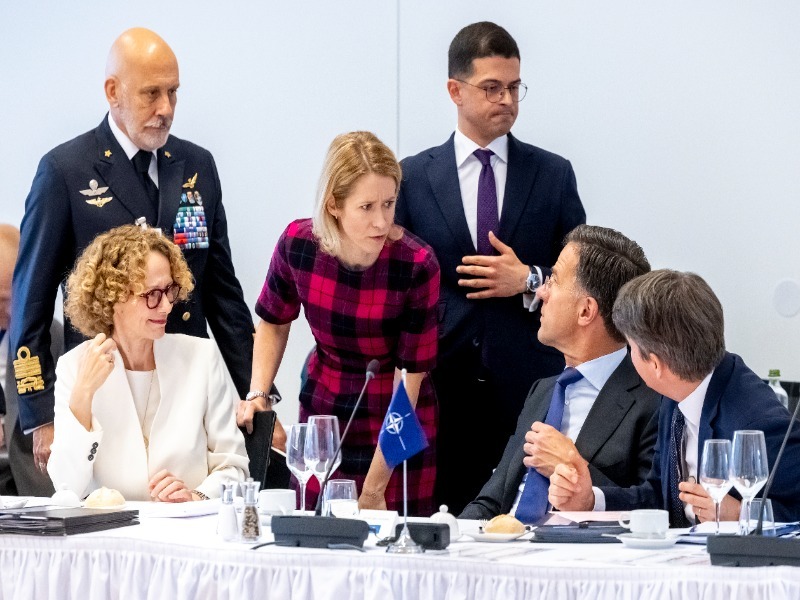
Photo retrieved from NATO.