In August 2022, the Iranian supply of lethal drones to Russia sparked international debate as their use in Ukraine became apparent. From 2026, this aspect of the Iranian-Russian relationship has become reciprocal. Confidential documents obtained by The Economist suggest Russia offered to provide Iran with un-jammable drones and training to combat US strikes. Similarly, Ukraine signed a deal with Saudi Arabia in March 2026 to share its drone expertise and technology – supporting Riyadh in resisting Iranian attacks reminiscent of those Kyiv has resisted from Russia.
The crucial commodity in modern warfare is not only the drone itself, but the know-how accompanying its procurement and strategic deployment: including production techniques, operational tactics, and personnel training. Thus, emerging partnerships hinging on drone expertise create novel challenges and opportunities for NATO. The following essay assesses strengths and weaknesses of NATO’s drone expertise before identifying opportunities and threats present in this emerging market.
Strengths
NATO’s drone-expertise strengths lay in an institutional ecosystem of alliance-owned and operated assets, interoperability, collective testing and training, standardization, innovation acceleration pathways, and forums to absorb Ukrainian combat-tested insights. The Alliance Ground Surveillance (AGS) fleet’s centerpiece of seven years is a high-altitude, long endurance unmanned aerial vehicle (UAV) named RQ-4D ‘Phoenix’ – which is both NATO-owned and operated. The Phoenix’s strength is not technological exclusivity, but a multinational ownership model that provides smaller members access to costly technology. Further, it relays intelligence to NATO rather than individual states, which raises the alliance’s collective security standard and promotes shared situational awareness. Following Russia’s invasion of Ukraine, the Phoenix has flown hundreds of hours over the Eastern flank – collecting intelligence, surveillance, and reconnaissance (ISR) datasets, enabling allied awareness of movements at land, sea, and air. In 2025, the Phoenix conducted its first ISR gathering mission through the Greenland-Iceland-United Kingdom Gap after being launched from Finland. A notable distance from its home-base in Sicily, this mission demonstrates ongoing expansion of the drone operating environment. The fleet’s ownership and intelligence model also fosters collective training, and facilitates sovereign drone adoption by decreasing know-how barriers to entry, and incentivizes allied research.
The medium altitude, long endurance MQ-9A Reaper operated by the US, Italy, France, Spain, the Netherlands, and Poland demonstrate NATO’s strength in joint training and operations. These joint activities yield a key advantage: expertise through collective lessons learned. For example, the 2025 Formidable Shield exercise conducted the first MQ-9 Reaper flight out of Iceland with American pilots and Danish observers; Italian crews train on the MQ-9 at Holloman in the US; and the UK hosts MQ-9B Protector flight training at the Waddington Base under NATO’s Flight Training Europe (NFTE) program. Holloman’s and Waddington’s programs exemplify long-term training practices: Holloman offering continuous rotations of 3-4 month training schemes and Waddington’s program being designated as a recurring component of the NFTE. Joint training and operations, particularly recurring ones (e.g., Holloman, Waddington), demonstrate alliance readiness, strengthen collective knowledge, and enhance interoperability and coordination – all refining NATO expertise and allied drone usability.
The standardization of control-station architecture, data linkage pipelines, and data formats promotes interoperability by allowing compliant ground stations to access sensor footage in real time and in retrospect through the same data formatting languages. These interoperability capabilities are enabled through standardization agreements under NATO’s ISR Interoperability Architecture (NIIA) including those for UAV control, data linkage, and data formatting (e.g., for video or Ground Moving Target Indicator data.) The Modular Open Systems Approach (MOSA) showcases interoperability expertise through standardisation. For example, the General-Atomics Aeronautical System’s ‘NATO Pod’ bolts onto an MQ-9 and, through a common interface, allows allies to connect sovereign sensors to a common airframe without modifying the entire aircraft. Interoperability and standardisation are itself expertise but also encourages proficiency by establishing common technical language, tactics, training modules, and proofs of concept enabling adoption and deployment.
NATO has also institutionalised drone-knowledge sharing through the NATO-Ukraine Joint Analysis, Training, and Education Centre (JATEC) alongside the Joint Analysis and Lessons Learned Centre, drone-focused Centres of Excellence, and the DIANA innovation accelerator; collectively promoting allied capability, expertise, and goal-setting.
Weaknesses
NATO’s weaknesses are concentrated along supply chains. Though Ukraine and NATO allies are diversifying their suppliers, Chinese components continue to dominate the market for drones and their components. DJI, a Chinese company, maintains about 80% of the global consumer drone market. Substitution costs explain the challenge to decreasing the dependency: a Chinese motor costs $12-25 while its US-made counterpart costs $100-225. Poor technological sovereignty over components means NATO’s production is limited by access to Chinese goods and services; a proven risk evidenced by China’s 2024 export restrictions on drones and drone components to Ukraine and Russia.
NATO’s procurement model structure is also a weakness. Rooted in a Cold-War approach to weaponry, it treats products as singular and indivisible, with one contractor delivering an entire system as a package. Upgrades and iterations slow as changing one component requires modifying an entire system, renegotiating contracts, and restarting testing cycles. While the emerging MOSA closes this gap, implementation is inconsistent and much of NATO’s machinery has not yet caught up. The procurement model and reliance on Chinese components undermines the development of allied industrial and production expertise required to scale, tailor, and iterate products at the necessary pace.
Simultaneously, while sales of US-made platforms transfer hardware ownership to allies, technical knowledge remains guarded. Internal algorithms, source code, maintenance manuals, and more sit behind International Traffic in Arms Regulations (ITAR), and are subject to release controls. ITAR restrictions stifle allies’ technical expertise, as software teams and engineers cannot analyse or learn from products’ internal technical composition. NATO dependency is thus two-tiered, relying on both China and the US; while limiting technical expertise and production capacity. Last, despite knowledge-sharing mechanisms, there remains an inherent gap between the speed at which combat-tested expertise is generated and the rate at which NATO can absorb it.
Opportunities and Threats
Opportunities to decrease reliance on Chinese supplies may eventually materialize , in part, from Ukrainian parts-procurement as Ukrainian efforts towards sovereign production have yielded preliminary success. As an example, it can be argued that greater absorption of Ukrainian know-how will mimic embedded journalism: NATO observers may visit Ukraine to study drone development and production processes, as opposed to waiting for Ukrainian personnel to relay information back to NATO. Political constraints may be mitigated by sending non-political personnel (e.g. engineering SMEs) who could regularly relay information to alliance headquarters.
Drone expertise has also proven generative of diplomatic opportunities, as demonstrated by Ukraine’s deal with Saudi Arabia in March 2026, and Taiwan’s work alongside Poland and Czechia. Expertise-sharing and partnerships within the emerging drone market may create security cooperation arrangements and expand diplomatic ties.
That said, such opportunities are hampered by NATO allies’ principal adversaries: Iran and Russia. The drone expertise cultivated by Moscow and Tehran pose concrete threats to NATO, as Russia has frequently used Iranian Shaheds throughout the war in Ukraine, and Iran has reportedly used Russian-made Shaheds (likely the Geran-2, Russia’s variant of Shahed 136) to attack US bases during the 2026 U.S. aerial/naval campaign against Iran. Further, the Iranian and Russian expertise offers states seeking partnerships an alternative to NATO and allies.
To conclude, NATO’s drone strategy holds strengths in interoperability, coordination, and standardisation while weaknesses lie in technological sovereignty, where allies face dependencies on both China and the US alongside a limited speed of knowledge-absorption. Opportunities include deepening Ukrainian, Gulf, and Indo-Pacific partnerships, but the alliance must remain cautious of rapidly developing expertise held by Iran and Russia. Ultimately, NATO’s primary challenge is mastering rapidly evolving technology faster than its rivals. The ultimate question is whether NATO’s resources can effectively simulate combat-testing and produce iterations at combat-pace, or if rapid iterations and lessons learned are truly exclusive to warring states.
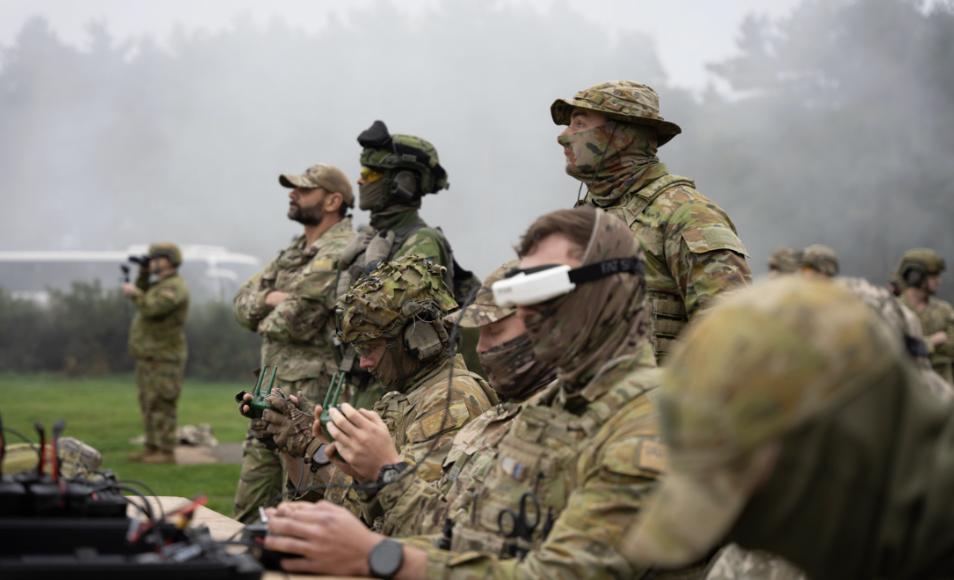
Image Citation: “Training mission for Ukrainian soldiers evolves to keep pace with drone threats on the battlefield” (2026), NATO
Disclaimer: Any views or opinions expressed in articles are solely those of the authors and do not necessarily represent the views of the NATO Association of Canada.