Introduction
Responding to Russia’s invasion of Ukraine, Poland has quietly but steadily emerged as a significant military force within Europe and NATO. In just a few years, the Polish military has dramatically expanded in size, diversified its defence procurement and production, and embedded itself as a key NATO partner willing and able to confront Russian aggression. This achievement is all the more impressive given Poland’s relatively modest size, numbering just over 40 million people and a GDP of around 1 trillion. Poland has driven this growth through policies centred on diversification and creativity, dispersing the risks of procurement and engineering new ways to fund its armed forces. Given the success of Polish policy in expanding its armed forces, Canada should observe and learn from its European ally. By emulating aspects of Polish defence policy, Canada, seeking to dramatically expand its armed forces, may find a functional template for rebuilding the Canadian Armed Forces.
The Importance of ‘Buy Now, Build For The Future’ Defence Spending
One approach enabling Poland’s success in rearming has been balancing the need to buy now whilst not neglecting industrial capacity for later. Poland has correctly gauged that defence production cannot be perpetually outsourced, and has committed to dramatically expanding Poland’s domestic production capacity. This has allowed Poland to source nearly 50% of its military equipment orders from domestic producers, while continuing to stipulate production cooperation instead of outright purchases of foreign military hardware. However, Poland balances this approach with its acknowledgement that it must purchase military equipment immediately through foreign partnerships. To address this, Poland has diversified its defence procurement, purchasing quality equipment without overrelying on any one partner. Poland has maintained procurement relationships with the United States, deepened cooperation with European partners, and has forged new defence partnerships with defence suppliers such as South Korea. This approach has insulated Poland against supply chain disruptions, while allowing Poland the ability to pivot between partners if needed.
Canada should emulate Poland’s approach of “buy now, build for the future”. While Ottawa has committed to ramping up domestic production through Canada’s Defence Industrial Strategy, it has also signalled that Canada must procure defence goods from other partners to address immediate gaps, under the ‘Build – Partner – Buy’ framework. However, Canada should not substitute American reliance with reliance on another source such as Europe. To do so risks other bottlenecks and disruptions to defence procurement should another geopolitical shift occur. Agreements like the TKMS submarine program should be matched with commitments to purchase other goods from different sources. South Korea, the runner-up for Canada’s submarine program, produces many other systems Canada needs for its defence, such as self-propelled artillery and infantry fighting vehicles. Likewise, Japan lifted an export ban on military goods in April of 2026, opening the door for Japanese industry to satiate defence demand globally. Canada must realise that it may not be able to wait for its industry to catch up, and must be prepared to explore diverse partnerships in order to secure what it needs for defence. While serviceability and interoperability with allies should be the principal consideration for defence procurement, Canada should embrace the broader diversification which Poland does. Thus far, Canada has largely pivoted from US imports towards European and domestic production. However, the case study of Poland demonstrates Canada should be willing to look even farther afield, to emerging markets like South Korea and Japan, allowing Canada to build diverse supply chains while domestic industry ramps up production.
Creative Means of Funding Defence
Equally important to where a country buys its military hardware is the issue of how it finances these purchases. To address this, Poland has created means to fund its armed forces beyond simple budget increases. Domestically, Poland has created the Armed Forces Support Fund. Managed by Poland’s National Development Bank, the fund allows the Polish armed forces to finance military investment through debt by issuing bonds, taking out loans and borrowing money. This funding is then directed to fulfilling Poland’s military contracts, and the National Development Bank manages repayment. Since its implementation in 2022, the fund has enabled Poland to access billions in investment for Poland’s armed forces from multiple partners. The fund also serves as a powerful foreign policy tool, offering allies a way to directly invest in the Polish armed forces and strengthen ties.
Ottawa has recently expressed interest in creating ways to finance projects in the national interest, such as the Canada Strong Fund. Coordinating with the Department of Defence to allow independent financing applications could help the Canadian Armed Forces secure desperately needed modernization funds, as modernization requirements appear to be becoming increasingly steep. Such a policy would also need to emulate Poland by maintaining proper oversight. While separate from state budgetary restrictions, the Armed Forces Defence Fund is still strictly regulated by the National Development Bank. Canada would likewise need to ensure any similar system includes the requisite oversight so it does not quietly become a slush fund for expenditures outside budgetary realities.
Conclusion
Looking at Poland, Canada can observe how a middle power is innovating the art of military expansion. Canada and Poland both face a similar challenge, that of ensuring sovereignty and deterring aggression without having to rely on a larger power for protection. In this vein, the experience of Poland’s relatively successful military expansion offers Canada the ability to inform its own approach to military expansion. Poland has demonstrated the need to diversify partnerships and introduce novel approaches to funding its armed forces. Canada can follow the example set by Poland through balancing domestic production with a dispersed supply chain, giving the CAF the tools it needs to fight today and building them for tomorrow. Additionally, Canada can look beyond budgetary increases to fund its military, and instead offer alternative approaches for the CAF to access financing, such as Poland has done through the Armed Forces Support Fund. While any approach would need to be unique to Canadian needs and particularities, Canada can draw inspiration from the Polish approach as it engages in its own military expansion.
Disclaimer: Any views or opinions expressed in articles are solely those of the authors and do not necessarily represent the views of the NATO Association of Canada.
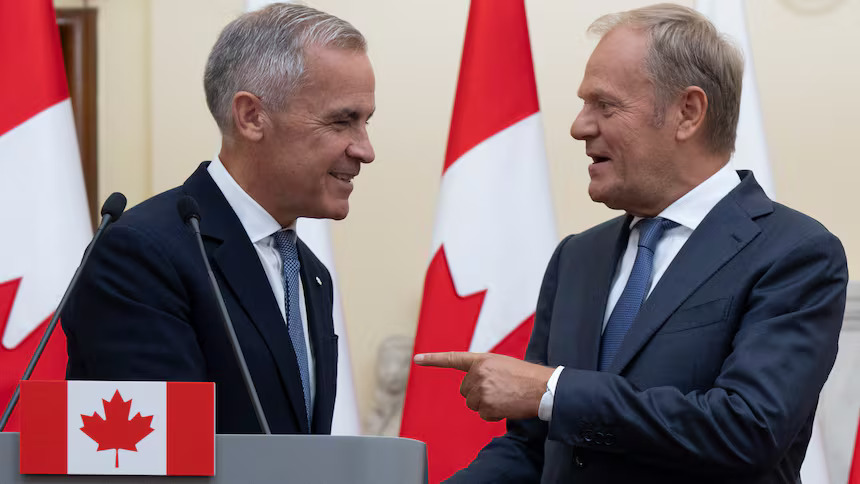
Photo: “Prime Minister Mark Carney, left, meets with Polish Prime Minister Donald Tusk,” via CBC. Public Domain.