NATO has answered the burden-sharing debate by throwing up a bigger number. At the 2025 Hague Summit, allies committed to raising defence investment to 5% of GDP by 2035, spending at least 3.5% on core defence requirements and up to 1.5% on broader defence spending. But spending is only an input into collective defence. The question posed is how those resources translate into capabilities and responsibilities. NATO’s collective defence rests on the principle that an attack on one nation state concerns the entire Alliance, but that principle has never required every ally to contribute in the same way. For much of its history, this responsibility has been distributed unevenly. In 2025, the United States accounted for roughly 60% of NATO allies’ nominal combined defence expenditure, despite only representing 52% of their GDP. As Europe’s security environment becomes more demanding and the United States has pressed its allies to assume greater responsibility, this has become more urgent. NATO should build on its existing approach to burden-sharing by placing greater emphasis on how defence spending translates into the capabilities and strategic responsibilities allies provide, rather than treating spending levels alone as the primary measure of contribution. American investment remains indispensable. The goal is instead to reduce NATO’s dependence on any single ally for the capabilities needed to sustain collective defence. For Canada, this means asking not only how much it should spend, but what responsibilities it is best positioned to undertake.
NATO’s current burden-sharing system is more differentiated than defence budgets suggest.The 2025 5% commitment is a national defence investment target, not a requirement for each nation state to transfer 5% of its GDP to NATO. NATO’s common budgets are funded separately through cost-sharing formulas based primarily on national GNI, while allies contribute capabilities through forces, equipment and infrastructure. The issue is not that NATO ignores these contributions, but that spending does not necessarily indicate how effectively it produces what the Alliance needs. What should be sought is how to more deliberately align existing capabilities and responsibilities.
This call to action did not begin with Donald Trump’s second term. Former American presidents have pressed allies to assume greater responsibility for decades. NATO Secretary General Mark Rutte has traced the demand back to the Eisenhower administration. What has changed is the intensity of political pressure after Russia’s full-scale invasion of Ukraine exposed European defence gaps. Under Trump, this pressure has begun to affect the distribution of American forces within NATO. In 2026, the United States adjusted its pledges to NATO’s force model, while announcing a 5,000-troop reduction in Germany and cancelling a planned 4,000-troop deployment to Poland. In June, Rutte emphasized that the United States remains committed to the Alliance, while describing its adjustment as part of a broader “division of labour.” The challenge is not just to increase spending, but to turn additional resources into a more long-term division of responsibility without replacing one form of dependence with another.
NATO is already beginning to redistribute responsibility within the Alliance. European allies and Canada increased their combined defence expenditure by nearly 20% in real terms in 2025, continuing a broader shift toward greater initiative in defence investment. But the more significant change is institutional. In February, allies agreed that European states would take on greater leadership within NATO’s military command structure, including command of all three Joint Force Commands at the operational level. The United Kingdom, Italy, Germany, and Poland, on a rotational basis, will share command from Norfolk, Naples, and Brunssum respectively. The United States will retain Supreme Allied Commander Europe and lead NATO’s three component commands, showing that greater European responsibility does not require removing American leadership. NATO is therefore moving toward a model that distributes responsibility more broadly without displacing the United States as the Alliance’s central military power.
But what should a more sustainable distribution look like? One possibility is to preserve the Alliance’s existing reliance on the United States as its dominant provider of military capabilities. This is a lead-organization model, where one capable member occupies a central position while other members contribute around it. This provides clear leadership and coordination, but creates a point of dependence. If the lead member changes its contribution, the Alliance is left vulnerable. A better solution is to distribute responsibility more broadly across the network. Rather than requiring one nation state to provide a broad range of capabilities, members could assume greater responsibility in areas where their geography and positioning give them particular advantages. This would create complementary contributions, with each ally contributing where it is most effective. NATO could coordinate this division of responsibility through its existing defence planning process, identifying capability gaps and finding areas where investment will make the greatest contribution. By reducing the concentration of critical capabilities on a single nation state, this approach would make the alliance less vulnerable to changes in any ally’s behaviour. Defence spending would therefore remain important, but as a means of producing capability rather than the ultimate measure of contribution.
Canada’s position within NATO is distinctive, making it well positioned to take on greater responsibility within the Alliance. Canada is simultaneously a North American, Arctic, and North Atlantic nation, which gives it strategic interests and responsibilities across multiple geographic areas. Canada is already assuming greater responsibility through its contributions to NATO’s eastern flank and other operations. Instead, Canada should concentrate additional resources on capabilities that reinforce its particular strategic advantages. This could include strengthening pre-existing programs of Arctic surveillance and domain awareness, cold-weather and northern military infrastructure and training, and maritime surveillance in the North Atlantic. These capabilities are expected to help Canada protect the northern and transatlantic approaches.
This approach would also offer a different way to think about accountability. Rather than asking only whether Canada has spent a particular percentage of GDP on defence, NATO could also assess whether Canada has developed and maintained the capabilities required to fulfill its responsibilities to the Alliance. Allies face different threat environments and possess different advantages, but the broader objective is collective resilience. A Canadian contribution that strengthens NATO’s ability to monitor, reinforce, and defend its northern and transatlantic approaches would provide value that cannot simply be captured in a spending figure alone. The more capable and complementary contributions become, the less vulnerable NATO is to a change in any ally’s contribution.
NATO’s burden-sharing policies in the coming years should not simply be about how much each member state spends, but how responsibility for defence is distributed. The United States remains indispensable to the Alliance, and there is no realistic substitute for its capabilities. But continued dependence on any one ally for such a large share of security responsibility creates significant vulnerability. A more sustainable model involves distributing responsibility according to the different strengths and strategic positions of all members. For Canada, this means assuming greater responsibility where its geography and capabilities provide an advantage, and measuring its contribution by more than defence spending. NATO does not need to choose between American leadership or greater European and Canadian responsibility. A more resilient Alliance is one in which the two reinforce each other.
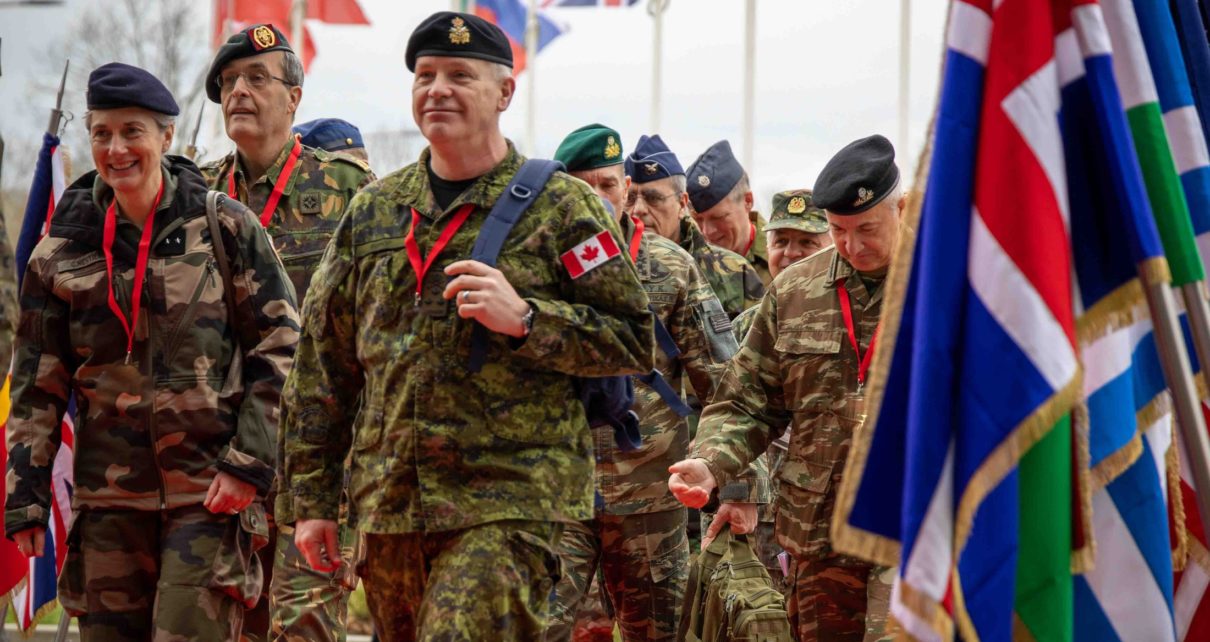
Photo: “The NATO Military Committee visit Allied Joint Forces Command Brunssum – 23 March 2023” (2023), by NATO North Atlantic Treaty Organization via Flickr. Licensed under CC BY-NC-ND 2.0.
Disclaimer: Any views or opinions expressed in articles are solely those of the authors and do not necessarily represent the views of the NATO Association of Canada.