Reconciliation Efforts Today
The government has stated plans to blend Indigenous culture and knowledge into the Canadian Armed Forces (CAF). That knowledge refers to a cultural lifestyle rooted in relationality with the land, animals, and community, and passed on through land-based learning rather than transferable skills. It encompasses ways of understanding people, environment, spirituality, and decision-making, distinct from standard military training. The Department of National Defence’s (DND) Indigenous Reconciliation Program, launched in 2023, was framed by Minister of Northern Affairs Dan Vandal as a way to “[ensure] Indigenous knowledge is applied to our collective defence and security.”
That commitment includes a $9.5 million investment over five years, funding Indigenous partners’ engagement on matters ranging from CAF exercises to infrastructure and policy research. The CAF has also set a target of 3.5 percent Indigenous membership by 2026, hoping to bring more lived experience into the institution. Training reflects the same intent: multiple CAF programs now pair standard military instruction with Indigenous epistemologies, building cultural teachings into how members are trained. Even the government’s highest level includes annual meetings between the Prime Minister and Indigenous leadership on defence and security.
On paper, these commitments describe a meaningful shift. Whether they extend genuine trust to Indigenous knowledge, or remain symbolic gestures, is a question this article answers by turning to the First and Second World Wars, when individual Indigenous soldiers already put that trust to the test.
The Gap Between Policy and Practice
These commitments are meaningful. However, implementation has remained inconsistent, with symbolic gestures too often failing to translate into genuine institutional practice. The Minister of National Defence’s own advisory panel, in a 2022 report whose findings remain just as relevant today, found Indigenous members were simply sought out as “a resource to assimilate, exploit and recruit when needed.” By the panel’s own account, Indigenous recruits were welcomed in, but found little support once enrolled. Traditional practices and ceremonies were rarely available, and those who spoke only their Indigenous language received little accommodation. Belonging, it turned out, was not the same as being included.
Sgt. (Ret’d) Wendy Jocko, an Indigenous CAF member who served 23 years in the CAF, described a broader institutional habit behind these same kinds of efforts in a 2026 Conference of Defence Associations (CDA) Institute review: Indigenous insights, she noted, are “too often brought into processes too late, when programs have already taken on scale and form.” Even well-intentioned initiatives tend to have their structure built first, with Indigenous knowledge folded in only afterward. This pattern has a direct cost: recruits who find their culture unsupported often leave and discourage others from enrolling. The numbers confirm it. Representation didn’t simply fail to rise, it fell, from 3.4% in 2020 to 2.9% by 2025, well short of the government’s own target. The gap suggests institutional commitment matters as much as resources.
Indigenous Knowledge On the Battlefield
What genuine autonomy and agency over that knowledge could produce today in CAF training remains unknown, because it has never truly been given the chance. To understand what Indigenous knowledge is capable of, it helps to look at a time it was able to fully emerge: the First and Second World Wars. During the crisis of live combat, close oversight of Indigenous soldiers became far harder to maintain, giving them greater latitude to draw on their own knowledge than the institution otherwise allowed. In that gap, Indigenous soldiers relied on instinct out of sheer necessity, where combat and culture combined decisively for survival. Three cases show how Indigenous knowledge emerged differently through each individual’s service, a glimpse of what training built on that same knowledge could mean for the Canadian Armed Forces today, and for reconciliation itself.
Charles “Checker” Tomkins
Grouard, Alberta is where Tomkins, a Métis soldier, grew up learning Cree from his parents and grandparents, the same language the Canadian government had spent decades trying to suppress. When the Second World War broke out, he and dozens of other Cree-speaking Indigenous soldiers were secretly summoned in 1942 and given a rare kind of trust: the chance to lead using Cree itself as a weapon of war. Relying entirely on their own fluency, they built an entire military code from scratch, inventing new Cree terms for concepts like tanks, bombers, and aircraft the language had never needed before. Tomkins then relayed messages from the battlefield itself, in communications that were never successfully deciphered by enemy forces .
John Shiwak
Shiwak, an Inuk soldier from Labrador, became one of the most accomplished marksmen in the British Army during the First World War. Veterans Affairs Canada notes he grew up in “ancestral Inuit tradition and became an expert outdoorsman,” hunting seals to survive, waiting motionless for one to surface for a single breath before taking one exact shot, the skill that made him deadly as a sniper. Newfoundland Regiment records place him as the best in his regiment, possibly the finest in the entire British 29th Division. In nine months, he was promoted to Lance Corporal, an advancement seldom given to any minority soldier at the time. Over a century later, he received a rare individual honour: a commemorative plaque unveiled in his name alone in France, inscribed in his own Inuttitut language.
Tommy Prince
An Ojibwe soldier from the Brokenhead Ojibway Nation in Manitoba, he became Canada’s most decorated Indigenous soldier using a skill built entirely on land-reading and stealth. That skill came from cultural practice, tracking and hunting on his reserve as his father had taught him, giving him an instinct for terrain difficult to reproduce through conventional military instruction alone. Recruiters for the Canadian-American “Devil’s Brigade” specifically sought soldiers with exactly this outdoor background. Once inside the unit, he carried out entire reconnaissance missions alone deep in enemy territory, vanishing so completely that, as one comrade recalled, German soldiers believed he was “a ghost or a devil.” He would go on to earn eleven medals across two wars, then spent his postwar years advocating for Indigenous rights
What Genuine Integration Requires
Current reconciliation efforts have made real progress: funding has increased, targets have been set, and training programs now exist where none did a decade ago. But progress is not the same as arrival. Funding, committees, and curriculum are policy tools; they are not the same as trusting Indigenous knowledge to shape how the Canadian Armed Forces actually operate. History has already shown what happens when Indigenous knowledge operates freely, not by policy, but by circumstance. There is no structural reason this could not be built into general training, not as a separate stream, but as something every soldier learns and relies on.
This is not a program added on top of the institution. It is Indigenous and Western knowledge trained side by side, neither treated as the default and the other as an accommodation. In practice, this could take many forms, one being hands-on wilderness training led by Indigenous elders and knowledge keepers, passing down land-based knowledge built over generations, not mere textbook lessons. Whether building that same freedom into training today would produce comparable results is something Canada has yet to test. The only question left is whether Canada is finally willing to find out.
Disclaimer: Any views or opinions expressed in articles are solely those of the authors and do not necessarily represent the views of the NATO Association of Canada.
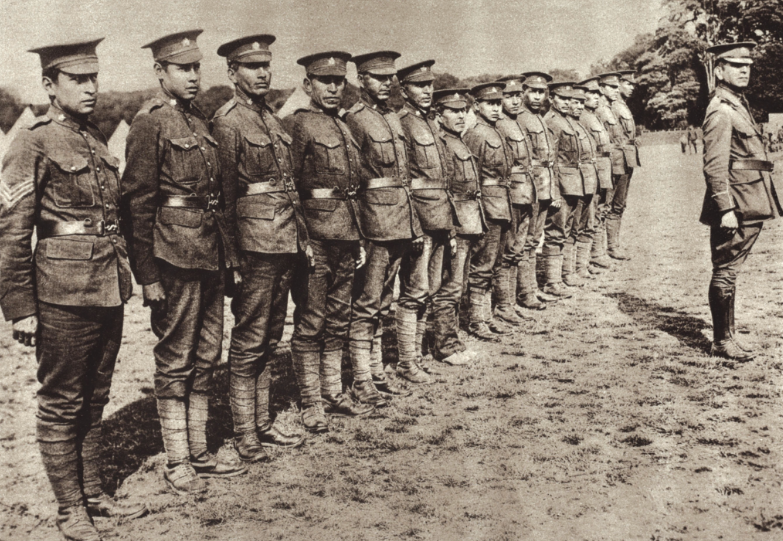
Photo: “Indigenous soldiers serving in the Canadian Corps on the Western Front during the First World War”, via Legion Magazine. Public Domain.