Amidst the Iran War, the Strait of Hormuz remains de-facto shut. Since the start of the war, Iran has restricted and at times closed completely maritime traffic through the Strait, while targeting ships with drones, small attack boats and mines introduced into the strait. The United-States proceeded to apply its own blockade of the Strait to restrict Iranian ships from exporting its oil. Despite both sides adhering to a Memorandum of Understanding with the goal of ending the war, thereby opening the Strait of Hormuz to its full extent, its validity is now stressed by the exchange of strikes between the US and Iran. Although a small number of tankers have been getting through, the volumes of oil imported from the Middle-East to East and Southeast Asia at present cannot meet national demands. This supply deficit poses a serious crisis for China, Japan, India, South Korea, and other Indo-Pacific economies that rely on oil exports from the Gulf States.
For Japan, 95% of its oil imports come from the Middle East, whilst 70% of Korea’s crude oil comes from the same region. For Vietnam, the percentage is 80%, mainly from Kuwait, which is transported through the Strait of Hormuz. For China, the estimate is 40-50%. While many Asian countries have started to release their strategic oil reserves to meet energy demands Asian financial markets have experienced increased volatility due to energy shortage. Southeast Asian countries like the Philippines, Vietnam, and Thailand likewise are cutting down on energy usage, such as having air conditioning no lower than 24 degrees Celsius and working from home.
In the past few years, Canada has sought to diversify its trading partners and global presence amidst a changing geopolitical landscape. Aside from Europe, the Asia-Pacific region has been a key target for Ottawa, with Strategic trade partnerships having recently been struck with China, Japan, South Korea, and India. To further such rapprochement with the goal of extending Canada’s relevance in the region, exporting energy native to Canada’s territory to the region can enhance the overall geopolitical importance of Canada vis-à-vis Asia.
Canada’s energy, specifically its crude oil, unlike Russia’s or Iran’s, is not sanctioned by Western countries. It is therefore an attractive option for countries to purchase from, with the likes of TMX (Trans-Mountain Expansion Project) gaining traction from Chinese refineries. Furthermore, Canada’s natural gas exports have increased in 2026 to non-US markets. Not only is it abundant, its attractiveness for reducing greenhouse emissions over coal and alternative sources of natural gas has been internationally recognized. Unlike Russia and Iran who are currently at war, or Gulf States vulnerable to attacks from Iran, Canada is a predictable, safe, and stable country. With the exception of the United States, itself the subject of increased concerns about geopolitical unreliability, Canada is the only G7 economy capable of large-scale energy exports to Indo-Pacific states.
Becoming a key energy supplier to the likes of Japan, Korea, China, and ASEAN countries would not only allow Canadian companies to further expand access to Asian markets, but to receive attention from these nations. Having a key presence in the region incentivises Asian countries to invest in Canada, both financially and politically. Lee Kuan Yew once explained why young Singaporeans ought to study in the United-States instead of traditionally attending Oxbridge. The reason was the absence of British MPs travelling to Southeast Asia whilst pivoting their focus onto Europe exclusively. On the contrary, American senators took regular working trips to the region. The end of Empire and the rise of the United-States as a superpower fueled such policy shift for the UK. Being an energy supplier to the Asia-Pacific will naturally push the political establishment to seek closer ties with both the Canadian government and Canadian private enterprise. Developing key relationships and understanding of the biggest investor and geopolitical player in one’s home region bears great importance. Canada’s further investment into the region could produce a generation of politicians, bureaucrats, jurists, economists, and more, trained in Canadian universities. Canadian firms and businesses seeking to penetrate highly protected domestic markets in Asia may gain preferable access in lieu of an energy export upswing.
There has been various political roadblocks for such ambitious goal. Bill C-48 forbids oil tankers from stationing in Northwest British Columbia. At the same time, political factors unique to Canada’s confederation hinders its ability to fast-track energy projects. Contradictory regulations and a divergent set of policy from various communities and levels of government have historically inevitably slows down centralized policy making. Despite such difficulty, Mark Carney’s Liberal government have partnered up with Danielle Smith’s provincial conservatives to advance the West Coast pipeline project, which will allow oil to reach the Canadian West Coast. This project will facilitate export of oil to Asian markets.
Regarding most recent developments of the Iran War, the Middle East energy crisis will most likely continue in the forecastable future. Its negative effects on Asian economies has affected growth forecast for the remainder of 2026. Coping mechanisms enacted by Asian countries remain a bandage solution to a great problem, with Indonesia buying Russian oil, or other nations purchasing expensive US oil.
Canada sits at a comfortable position with record sales of its natural resources to Asia in 2026. Yet, a changing global geopolitical outlook provides a rare opportunity for the country to establish itself in the Indo-Pacific. For Ottawa to successfully reach heights akin to a energy powerhouse capable of extending its influence to a region far away, it needs to tackle the agonizing challenge of domestic politics, which has prevented a nation-wide unified energy strategy. Similar to post-Brexit UK, Canada has struggled to define what kind of country it wants to be. To attain the heights of a global top energy exporter, changes in both Ottawa and Provinces will have to take place.
Disclaimer: Any views or opinions expressed in articles are solely those of the authors and do not necessarily represent the views of the NATO Association of Canada.
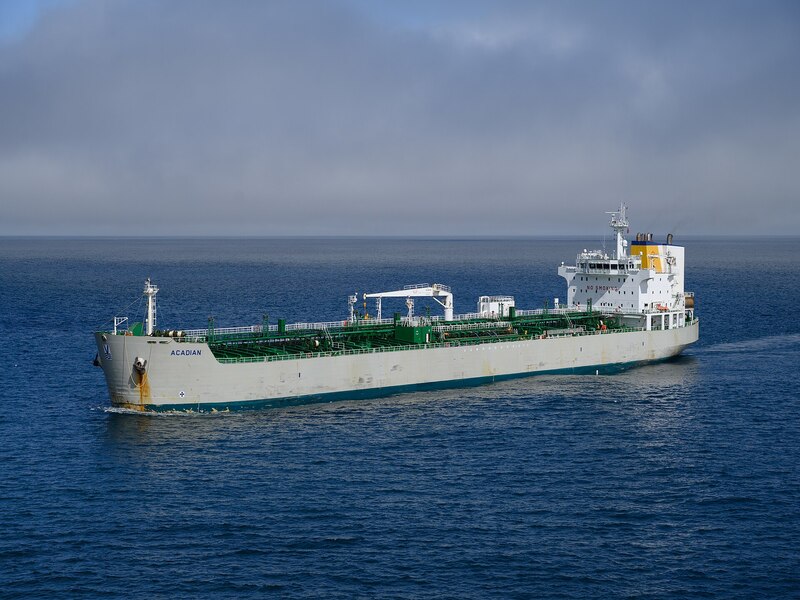
Photo: Chemical and oil products tanker, Acadian, coming into The Narrows and St. John’s Harbor, Newfoundland, Canada. Licensed under Creative Commons.