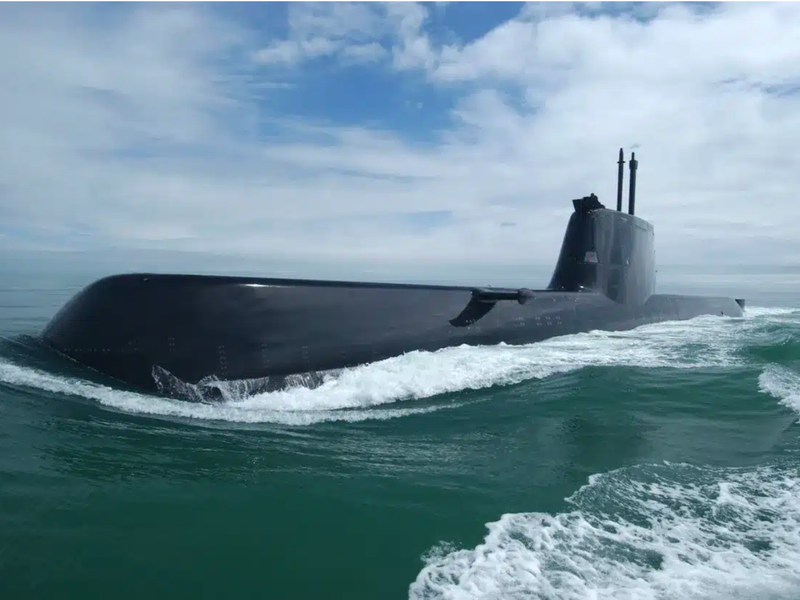
Ottawa has selected Germany’s TKMS for Canada’s next submarine fleet, choosing it over South Korea’s Hanwha Ocean for a project that could reshape the navy for decades. Public debate has focused on jobs, domestic shipbuilding work, delivery timelines, and Alliance alignment. The question that should anchor the project has received far less attention: what will this fleet actually do for the Canadian Armed Forces (CAF)? Its value will depend on whether it can provide persistent undersea awareness, strengthen deterrence, and support continental defence across Canada’s maritime approaches.
Canada’s Undersea Shortfall
Canada’s four Victoria-class boats were acquired second-hand from the Royal Navy in 1998. They remain capable submarines, but in recent years, the fleet has rarely generated sustained sea time across all four boats. To extend their service while the replacement fleet is built, the Victoria-class Modernization project is intended to keep the boats operationally relevant into the mid-2030s, by which point Ottawa wants the first of up to twelve new submarines delivered to avoid a capability gap.
Even under TKMS’s proposed schedule, with first deliveries by 2034, the transition window is tight, and the current fleet will continue to age in the interim. Expanding from four boats to as many as twelve is also a crewing problem: keeping just one submarine continuously available on a single coast takes roughly four boats, according to Vice-Admiral Angus Topshee, commander of the Royal Canadian Navy. This is how a three-ocean requirement becomes a twelve-boat fleet. That growth will test crews, training, basing, and sustainment capacity long before production lines become the main constraint.
Without a dependable undersea force, the CAF remains limited in its ability to monitor, contest, and deter activity across Canada’s maritime approaches. A larger fleet would prevent further capability decline while strengthening Arctic operations, continental defence, and deterrence.
What the Fleet Must Deliver
NATO identifies Russia as the most significant and direct threat to Euro-Atlantic security, while also naming the People’s Republic of China’s ambitions and coercive policies as a growing challenge. Canada’s own defence policy, Our North, Strong and Free, reflects the same shift, pointing to the destabilizing impact of climate change on the Arctic, and new threats from a changing physical and geopolitical landscape. A growing share of that challenge lies below the surface.
Russian submarine activity in the North Atlantic and around the Greenland-Iceland-UK gap has again become central to NATO planning. That concern is now reflected in Arctic Sentry, the NATO initiative launched in February 2026 to strengthen Allied posture in the Arctic and High North. China presents a longer-term challenge as its growing fleet and self-declared status as a near-Arctic state make it increasingly relevant to Arctic planning.
Submarines provide persistent, covert surveillance and can track hostile vessels without revealing their position. This is especially important under ice, a stated requirement of the Canadian Patrol Submarine Project and a strength of TKMS’s bid. In practical terms, that capability gives the CAF three operational advantages.
The first is awareness. Submarines can collect acoustic signatures and track the movements and operating patterns of foreign vessels in waters Canada cannot monitor continuously. This intelligence is especially valuable where ice can limit aircraft and surface ship operations. It would give commanders a clearer picture of activity in Canada’s northern and maritime approaches.
The second is deterrence. A credible undersea force compels a competitor to account for a platform it may not be able to locate. Canada’s own description of its submarine fleet makes this point directly: the mere possibility that a submarine is operating undetected can alter the entire nature of a crisis or conflict. That uncertainty raises the cost and risk of operating near Canada.
The third is integration with the wider force. What a submarine detects doesn’t stay within the Navy. DND’s framework for pan-domain command and control recognizes maritime, land, air, space, and cyber as interdependent domains, and specifically ties maritime and aerospace warning to maintaining awareness across land, space, cyber, and the information environment. The fleet would also strengthen Canada’s contribution to Allied anti-submarine warfare in the North Atlantic, including through NATO exercises in which Canada already participates.
The submarine file therefore ties fleet renewal to continental defence and North American deterrence. Submarines would help Canada detect, understand, and complicate threats moving through its maritime approaches, the very spaces where Arctic security and North Atlantic defence now overlap.
Below the Surface of NORAD Modernization
Canada’s $38.6 billion NORAD modernization plan, announced in 2022 and spread over twenty years, is designed to improve the detection of threats approaching North America. At the time, it marked a significant but measured investment, reflecting a cautious approach to defence spending; Ottawa has since moved toward more ambitious efforts to meet NATO targets and strengthen the military. Almost all of the NORAD investment, however, look upwards.Its five investment areas, surveillance, command and control, air weapons, northern infrastructure, and research, focus largely on the air and aerospace domains and acting faster on what is found.
NORAD’s mandate covers aerospace warning, aerospace control, and maritime warning. Anti-submarine warfare remains a national responsibility, led in Canada by the Royal Canadian Navy. Effective maritime warning depends on the surveillance picture available to Canada, including its ability to detect activity below the surface.
Radar and satellites cannot independently detect and trail a modern attack submarine approaching North America. Canadian submarines could help fill that gap by locating and tracking vessels before they reach a position of advantage.
The same waters contain seabed cables and energy links that support military, government, and civilian activity. NATO’s Baltic Sentry patrols show how seriously the Alliance now treats threats to critical undersea infrastructure. Canada similarly needs persistent awareness of vessels operating near its critical infrastructure and maritime approaches.
The TKMS selection creates an opportunity to strengthen that undersea picture. The fleet’s contribution will depend on fleet availability, trained crews, domestic sustainment, and allied integration. Ottawa should secure those conditions during contract negotiations and early implementation.
What Ottawa Should Do
Contract negotiations will determine whether Canada can sustain the fleet domestically. Ottawa should secure access to technical data, diagnostic tools, repair authority, licensing arrangements, and stocks of mission-critical components. These provisions would reduce dependence on foreign suppliers and improve fleet availability.
The Royal Canadian Navy should also establish a platform-specific transition plan well before the first submarine arrives. Expanding from four Victoria-class boats to as many as twelve new submarines will require more crews, instructors, simulators, shore facilities, and maintenance personnel.
Canada should also formalize training and exchange arrangements with Germany and Norway, which are acquiring the same submarine design. Instructor placements, maintenance training, sea time, and joint exercises would give Canadian personnel platform-specific experience before the first boats enter service.
These measures would help convert the procurement into a sustained operational capability. Success will depend on Canada’s ability to keep enough submarines crewed, maintained, and at sea across its Atlantic, Pacific, and Arctic approaches.
Photo Credits: https://www.navalnews.com/naval-news/2025/09/tkms-emerges-as-frontrunner-for-indias-submarine-contract/
Disclaimer: Any views or opinions expressed in articles are solely those of the authors and do not necessarily represent the views of the NATO Association of Canada.