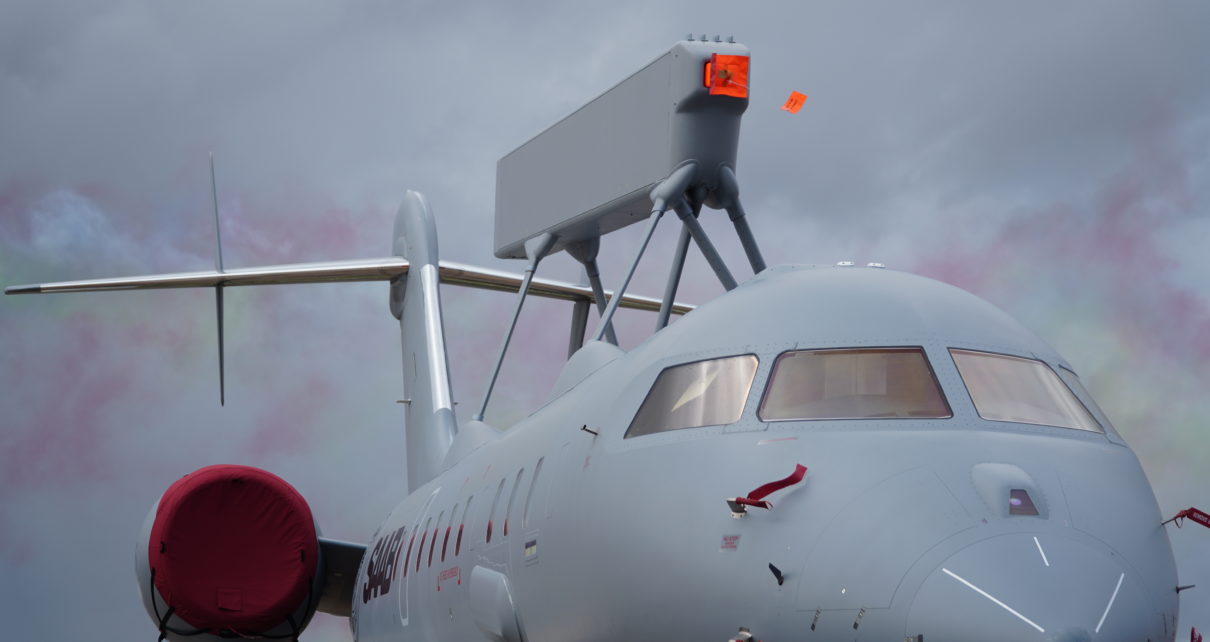
Recent reporting suggests that NATO plans to acquire between 10 and 12 GlobalEye aircraft — a joint Saab-Bombardier advanced surveillance system — to replace the American-made Boeing E-3 Sentry airborne warning and control system (AWACS). The value of the acquisition is likely to exceed $5 billion USD, with Canada-based Bombardier slated to earn $1 billion USD in revenue from the deal.
NATO has been actively seeking to replace the fleet since 2016, when, at the Warsaw Summit, member states affirmed the need for a new surveillance fleet by 2035 to meet its high-level military requirements. In use since the mid-1980s, its current fleet of 14 Boeing E-3 Sentry aircraft has been rapidly approaching retirement from operational duty. The GlobalEye, by contrast, represents a clear-cut upgrade. Boasting a lighter, more fuel-efficient airframe, Saab and Bombardier may deliver greater endurance while keeping operating costs down. The GlobalEye also provides faster target detection through its active electronically scanned array (AESA) — a significant upgrade from the E-3’s mechanically rotating rotodome. Moreover, the GlobalEye’s comparative advantage extends to its sensor range, which enables target identification at distances of up to 550km at an altitude of 35,000 feet. As a result, the GlobalEye will provide NATO with a surveillance fleet that is both operationally superior and more efficient, enabling it to bolster its Joint Intelligence, Surveillance and Reconnaissance (JISR) capabilities — a key pillar of its deterrence and defence posture.
Though technically consequential, the acquisition also points to a strategic pivot that extends beyond the technological upgrade: a shift away from the United States. In the current environment, the U.S. has emerged as an unpredictable power broker and has taken a more critical stance towards NATO. For instance, over the past year, Trump has threatened the sovereignty of fellow NATO member states, threatened to pull the U.S. out of NATO and gone as far as to pull out 5,000 troops from Germany in retaliation for German Chancellor Friedrich Merz’s criticism of American strategy in Iran. As such, NATO countries have begun to diversify their defence procurement, eschewing U.S. suppliers in favour of alternatives. This underpins NATO’s motivation to move away from Boeing — its common airborne surveillance supplier since 1982 — and absorb the potential costs of turning to a new supplier after almost fifty years.
Being on the receiving end of what Andrew Coyne described as “[a] miracle…occurring on the defence front”, Canada stands to benefit from this shift. Trump’s foreign policy and its cascading effects on international security have prompted Ottawa to reprioritize defence, as seen in new, unprecedented commitments and policies, such as a pledge to invest 5 percent of Canada’s annual GDP in core defence requirements by 2035, in line with the Hague Summit Declaration. This also extends to Canada’s homeland defence, where Canada has placed significant emphasis on projects such as its soon-to-be-finalized submarine procurement. The federal government appears to recognize this fertile ground, with its recent Defence Industrial Strategy (DIS) directly fuelling efforts to both strengthen Canada’s defence industrial base and meet the new 5 percent NATO spending target. The DIS fills a crucial gap in Canadian strategic thinking, which once facilitated the siloization of the defence industry from the broader economy. In rectifying this, the DIS projects “$180 billion in total direct investment in defence procurement, $290 billion total investment in defence-related infrastructure, and $125 billion in downstream economic activity.”
In the long term, reinforcing the link between the economy and the defence sector will be key to achieving success. Canada has long faced a moral and strategic trade-off when raising defence expenditures, given the retrenchment of social policy that accompanies it. Canada’s renewed effort to increase defence spending follows this trend; Ottawa seeks to make fiscal space by cutting programs such as the Early Learning and Child Care Program and Canada Summer Jobs. Conventional social policy scholarship posits that such retrenchment will have concentrated impacts on stakeholders that are unlikely to be offset by comparatively diffuse military and economic benefits. However, the growing public support for defence spending and the expected economic benefits outlined in the DIS can offer the Carney government ways to manage the perceived opportunity cost by highlighting the dual benefits afforded to Canadians through the simultaneous expansion of defence and the economy.
For its part, the GlobalEye deal will bring real economic benefits to Canada. The GlobalEye consists of Saab-made surveillance technology mounted atop a Bombardier Global 6000/6500 jet. These Bombardier aircraft are built in Toronto, creating new jobs for Canadians, in addition to the scattered economic benefits from over $1 billion USD in revenue for Bombardier. Further, in addition to jobs created by the GlobalEye deal, the DIS foreshadows 125,000 new jobs in the defence sector — a very welcome figure given Canada’s current unemployment crisis.
Aside from labour-market benefits, the GlobalEye deal, as reported in the Globe and Mail, will also deliver knock-on effects for other players in the Canadian defence landscape, with Montreal-based CAE well-placed to provide training for the new NATO fleet. Beyond this, the deal creates a demand signal for the Canadian defence industry as a whole. The ability to capitalize upon this demand hinges on the development of small and mid-sized defence businesses (SMBs) in Canada, which account for 92 percent of Canada’s defence industrial base. The ability to meet this moment, therefore, relies on the growth and integration of SMBs into domestic and international defence and security supply chains. Importantly, the DIS earmarked $357.7 million to grow the SMB sector — a step in the right direction that the government ought to see through.
To conclude, the GlobalEye deal could mark the start of a new era for the Canadian defence industry. Shifting procurement patterns for both NATO and individual allies have given Canada an opportunity to grow its defence sector. As Canada itself continues to follow suit, the DIS and the GlobalEye deal signal Canadian readiness. However, as history has shown, promises of large increases in defence spending have often not panned out in Canada due to fiscal consolidation efforts and defence spending being lower in the hierarchy of spending priorities. Encouragingly, the current outlook is optimistic: the explicit link between the economy and the defence sector should, if done right, enable a virtuous cycle that will expand Canada’s economic growth rate. This will help sustain continued spending without requiring tax increases or significant cuts elsewhere. Yet, should Canada fail to see through its commitments signalled by the DIS and deals like the GlobalEye, it risks forfeiting not only the potential economic benefits, but also — and perhaps more importantly — its reputation as a middle power capable of meeting defence expenditure, procurement, and manufacturing goals.
Disclaimer: Any views or opinions expressed in articles are solely those of the authors and do not necessarily represent the views of the NATO Association of Canada.
Photo: “SAAB GlobalEye AEW&C” by intrepidexplorer82 is licensed under CC BY 2.0.