In the last two decades, the United Nations and NATO have established gender equality as a priority within peace and security initiatives, illuminating the need for a “gender perspective” in internal and external practices. Towards this end, the Women, Peace, and Security (WPS) agenda was promulgated by the UN Security Council and endorsed by NATO to promote women’s roles in peacekeeping operations and drive gender mainstreaming efforts, through four key pillars: Prevention, Protection, Participation, and Relief and Recovery. However, this agenda does not explicitly recognize other varying factors that place women in unique circumstances that cannot be adequately addressed simply by gender alone.
Overlapping structural barriers, including racism and social inequalities, work to limit women’s agency by reinforcing problematic assumptions around gender and reasons for women’s inclusion. While NATO is primarily a defensive military alliance, it also engages in crisis prevention and management activities, which include peacekeeping missions or stabilization and security operations that occur in post-conflict contexts. These efforts could benefit from a more holistic understanding of how varying identities (e.g., race, class, sexuality) can impact organizational, institutional, and field-level effects in the conflict resolution process.
There is a broad consensus that women and girls are more vulnerable to incidents of violence, specifically sexual and gender-based violence, which is especially relevant in peacekeeping contexts. This vulnerability is explicitly recognized in UN Security Council Resolution 1325, which established the WPS agenda in 2000. However, critics point out that the WPS agenda’s treatment of women’s identities can be one-dimensional, which further marginalizes their position in peace and security settings.
The 1995 Dayton Accords, which established a fragile peace agreement regarding the war in Bosnia and Herzegovina, illustrate how gender overlaps with other identities and the consequences of failing to consider this. Conflict stemmed from divides between various ethnic groups, and sexual violence against women was used as a tool of war. However, these accords neglected to include provisions that addressed the mass cases of sexual assault, rape, and human rights violations that occurred. The subsequent United Nations International Criminal Tribunal for the former Yugoslavia recorded the testimony of survivors, including a 15-year-old muslim Bosniak girl who described her experience of torture and rape from being held captive by Serbian soldiers. These experiences cannot be defined singularly by only gender, as there were many other overlapping layers of identity (including ethnicity, nationality and religion) which produced the particular experiences of violence in the conflict.
Multiple factors, such as gender, race, class, age, and sexuality, intertwine in defining people’s lived experiences. Concerning peace and security in conflict-affected societies, this “helps in understanding not only the kinds of violence people might suffer but also the varied interests, needs, agencies, and views toward what constitutes inclusive and sustainable peace.”
Ideas of gender, race, and ethnicity are fluid and perceived differently across geographical, cultural, and interpersonal contexts, which highlights the importance of approaching peacekeeping and security studies holistically. Considering the highly specific and situational nature of every mandated operation, employing a singular approach to peace and security, as in only accounting for gender as a factor, neglects the interwoven experiences that may affect the actions of individual peacekeeping personnel on the field or the organizational decisions made at the headquarters of a mission. Therefore, it is pertinent to consider other dimensions and their effects rather than homogenizing women’s experiences into a single category.
Research suggests that women’s participation in peace processes increases the likelihood of sustainable peace across varying geographic and cultural contexts, where both implicit and explicit factors, such as visible characteristics and intangible experiences, contribute to operational effectiveness and mission success. Notably, the importance of women involved in peacekeeping and civilian capacities is highlighted in conflicts where there are high levels of sexual and gender-based violence. For example, local female populations in Namibia, South Africa, and Rwanda were found to be more receptive and open to female personnel. This improved communication and trust, and reduced uncertainty around the UN Transition Assistance Group (UNTAG), UN Observer Mission in South Africa (UNOMSA), and UN Assistance Mission for Rwanda (UNAMIR), respectively.
While ideas of race and ethnicity can be abstract and vary across cultural contexts, they contribute to some extent to peace and conflict on interpersonal and systems-based levels, and are ultimately factors that can affect a mission’s outcome. Studies have found that deploying peacekeepers that originate from the region in which the mission is taking place, for example, operatives who present with characteristics of a similar racial heritage or speak the same language, resulted in better operational effectiveness and more stable post-conflict environments. Moreover, a larger percentage of women in leadership positions and on the police force in the United Nations Mission in South Sudan (UNMISS) saw positive impacts on stabilization dynamics; considering the gendered dimensions and prevalence of sexual violence in this conflict, female personnel were better able to connect with the local population.
Specific contextual considerations, such as local norms and cultures of a conflict zone, as well as the diverse variables that affect women’s experiences, should be thoroughly accounted for and clearly highlighted when determining the mission mandate. Considering local populations respond more positively to peacekeeping personnel who present outward characteristics with which they are familiar, mission planning should integrate these specific influences, as ground-level changes have large overall impacts on the mission as a whole. These elements can be further incorporated in existing mission planning procedures, considering their positive effects on the success of peace processes while promoting women’s participation, one of the main pillars of the WPS agenda.
The WPS agenda reflects much more than just simply increasing the participation of women; NATO and other international organizations’ goal of incorporating gender perspectives into all aspects of its operations points towards the need to recognize the diverse experiences of women in conflict-ridden areas and those deployed in conflict resolution missions. Employing a one-dimensional approach to peacekeeping and conflict resolution limits the capacity for women to engage with and benefit from the WPS agenda, as higher levels of diversity can contribute to a more successful and well-rounded force. Integrating consideration of other social identities into existing frameworks could encourage a more holistic and effective environment for women in NATO operations.
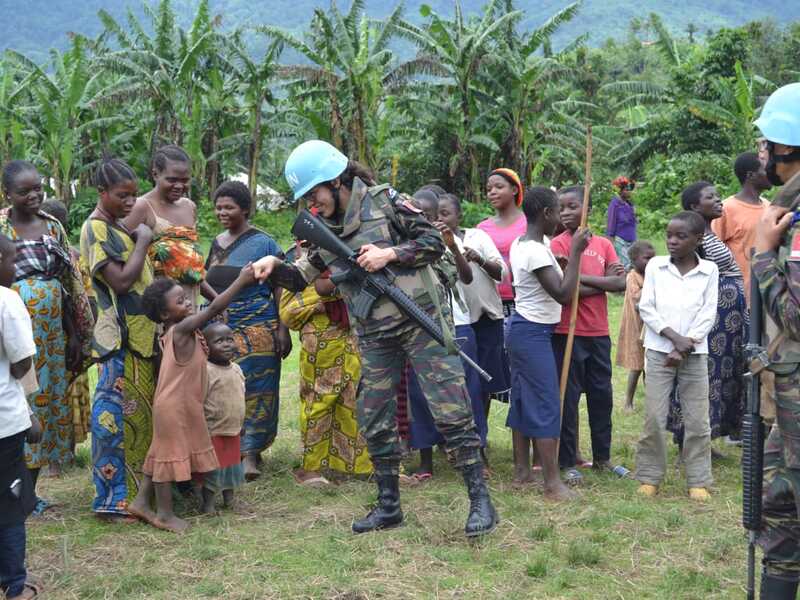
Photo: Kiwanja, North Kivu, DRC. The International Women’s Day offered an opportunity for female components of MONUSCO to build relationships with their counterpart women in the communities. The female engagement team of the Moroccan contingent in Kiwanja organized a function to honour women leaders in the community. At the end of the day, a stronger relationship had been built between the peacekeepers and the women of Kiwanja, enhancing collaboration to offer better civilian protection. Source: MONUSCO Photos, CC BY-SA 2.0, via Wikimedia Commons.
Disclaimer: Any views or opinions expressed in articles are solely those of the authors and do not necessarily represent the views of the NATO Association of Canada.