Since the 2022 Russian invasion of Ukraine, the European Union has moved to end reliance on Russian energy. On 26 January 2026, the Council adopted a stepwise ban on imports of Russian pipeline gas and liquefied natural gas (LNG), with a full ban on LNG from the beginning of 2027 and on pipeline gas from autumn 2027; the Commission also plans separate legislation to phase out Russian oil imports by the end of 2027. These moves seek to deny Moscow revenue for its war on Ukraine while unwinding one of the strongest points of leverage that Russia held over the continent. European governments have instead pursued new energy suppliers while accelerating the long-term transition to renewables.
EU Attempts to Decrease Dependence on Russia
In 2021, the EU depended on imports for 56 percent of its energy needs, a large part of which were petroleum products and natural gas (both LNG and pipeline gas). In both categories, Russia was the largest source of imports, accounting for 29 percent of oil and 39 percent of natural gas. By the third quarter of 2025, Russia provided just 1 percent of oil imports and 15 percent of gas imports.
Other suppliers—including the US, Norway, Qatar, Azerbaijan, Algeria, and others—quickly stepped in to fill the gap left by Russian energy, with LNG becoming a prominent replacement for piped Russian oil and gas through the EU Action Plan for Affordable Energy. EU energy markets have consistently increased their volume of imported LNG since 2021, despite decreasing their volume of imported oil and pipeline gas.
Enabling that transition is the US, which has spent the past decade building out the world’s largest LNG export capacity and is now the largest supplier of LNG to the EU. The US share of the EU’s LNG imports has steadily increased from 24 percent in Q1 2021 to 56 percent in Q3 2025. In a conditional scenario where contracted US supply expands and EU gas-demand reduction stalls, analysts project that the US could supply three-quarters of EU LNG imports by 2030, making LNG a significant point of leverage and dependency vis-à-vis the US for the EU.
As recent US relations with the EU have been increasingly disrupted by threats of tariffs and other measures, EU Energy Commissioner Dan Jorgensen has warned against replacing a dependency on Russian energy with another dependency on the US at a time when American behaviour appears unpredictable.
Implications for Canada and Europe
Provocations aimed at Canada’s sovereignty and recent statements by President Donald Trump about acquiring Greenland “one way or another” have implications for the deepening EU-US energy relationship. Leaders in Europe and Canada may consequently emphasize risk management in their relationships with Washington, and consider renewed opportunities to strengthen Canada-EU energy partnerships, including on LNG.
Canadian Prime Minister Mark Carney’s 2026 speech at Davos indicated his belief that accelerating global great power competition is heralding the start of a “new normal” characterized increasingly by blunt transactionalism and the unconstrained pursuit of power and interests. According to him, we will see “the most powerful pursue their interests using economic integration as coercion,” and sovereignty will increasingly depend on the capacity to withstand pressure.
In this new geopolitical environment, energy security is at the core of national sovereignty. The extent to which middle powers build relationships amongst themselves to mitigate dependencies on great powers will be a crucial element for their future resilience.
Aspirations to supply Canadian LNG to Europe are not new and would likely face significant obstacles. Notwithstanding the sentiment of the public or incumbent governments, projects will ultimately have to be led by the private sector, which will not act without a strong business case.
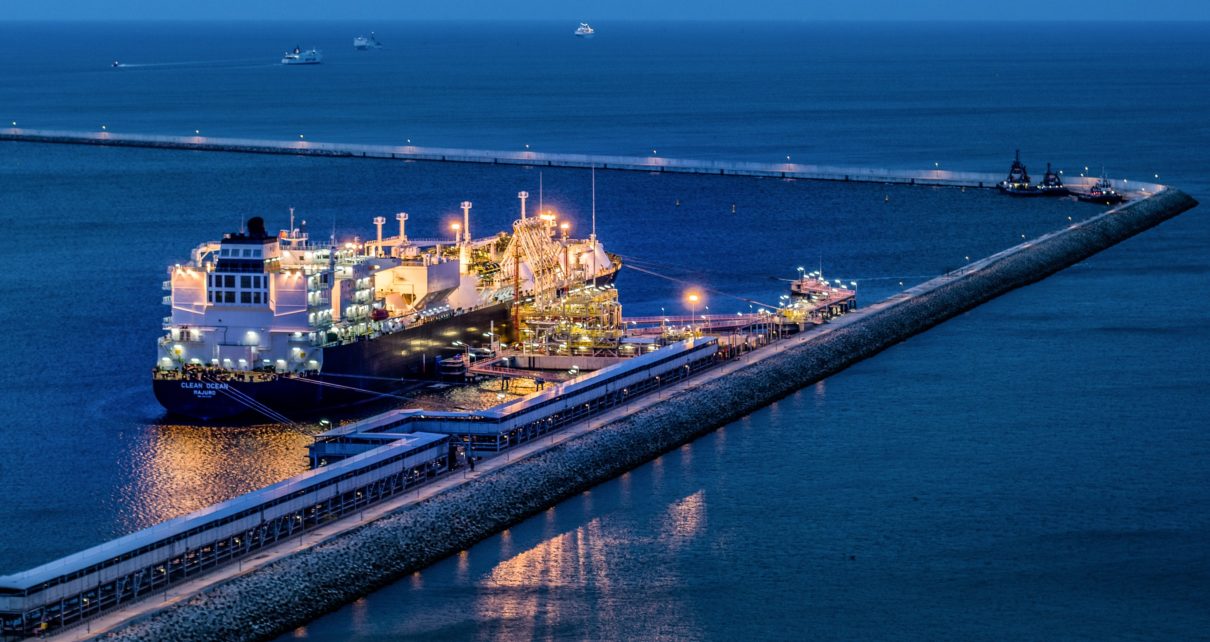
On the West Coast, Canada’s first large-scale LNG export terminal loaded its inaugural cargo from Kitimat in mid-2025. Additional West Coast projects are moving forward on later-decade timelines. However, West Coast output is positioned primarily for Asia-Pacific buyers. Canada’s main leverage point is not direct Atlantic deliveries but its contribution to global LNG supply flexibility that can indirectly ease European supply risk.
The Canada–US–EU Triangle in LNG
Many of the shortcomings that prevented Canadian LNG from supplying Europe five years ago remain today. Crucially, Canada lacks the necessary export infrastructure on its East Coast. Competition, cost disadvantages compared with such suppliers as the US and Qatar, and mismatches between project readiness and market demand have prevented long-term contract agreements and infrastructure development. High building costs, slow project progress, and weak economics have resulted in the cancellation or stalling of 18 Canadian LNG projects to date.
Meanwhile, since Lower-48 LNG exports began in 2016, the United States has expanded to eight large-scale LNG export terminals in operation, concentrated mainly on the Gulf Coast.
The EU also anticipates long-term demand to be affected as renewables are projected to continue displacing fossil fuels in its energy mix over the coming decades: this despite increases in the volume of LNG being imported into the EU, and despite import dependency remaining at 58 percent in 2023 (the latest available data). That reality compresses the window within which long-lived gas infrastructure can be financed on traditional terms.
Investments in Canadian LNG export capacity to Europe risk becoming stranded assets if demand falls as expected. Timing is another factor. Even with an agreement in place today, Tim Hodgson, Minister of Energy and Natural Resources, noted that the first delivery of Canadian LNG would not reach Europe for 5–7 years due to the necessary infrastructure buildout.
By then, supply gluts from new LNG projects in the US and elsewhere could constitute added competition. Existing long-term European contracts with other suppliers also present issues.
The European Attitude
Despite those challenges, the President of the European Parliament and representatives from Germany, Poland, and Greece all reiterated their interest in Canadian LNG as recently as 2024 and 2025. Plans to triple European domestic data centre capacity within the next 5–7 years, or to accelerate civil/defence industrial buildout, may also drive significant new electricity demand, increasing the need for dispatchable generation and potentially sustaining gas requirements.
The investment case for new East Coast terminals will depend on mitigating concerns around time-to-service, contract duration, and stranded asset risk caused by possible EU demand reduction.
Beyond the US, the EU’s next top LNG suppliers (Qatar and Algeria) each carry distinct risks. Qatar is located in the geopolitically volatile Persian Gulf region, susceptible to blockade or weaponization of the Suez Canal, Bab-el-Mandeb, and Strait of Hormuz. Algeria, which has its own issues with the EU (particularly with France and Spain) has already shown its willingness to use energy as leverage against an EU member.
Canadian LNG could thus command a “security premium” where EU partners accept a modest cost markup, or contract rigidity, in exchange for reduced exposure to coercion risk and supply disruption in a geopolitical era where security and reliability are crucial.
The Carney administration has signalled that it will take a friendlier approach than its predecessor to LNG development and energy exports as part of Canada’s trade diversification efforts. This aligns with a broader shift in Canadian sentiment. More than at any time since 2015, Canadians want to prioritize jobs, growth, and economic resilience over environmental considerations. They see energy as the sector with the greatest potential to achieve the Carney government’s goal of doubling non-US exports. When asked which export destination to prioritize, more Canadians named Europe (35 percent) than named either Asia (24 percent) or the US (19 percent), both of which already receive sizable Canadian energy exports.
Recommendations
Canada now has a large-scale LNG export terminal in operation on the West Coast, with additional projects at different stages of development. Canada can help mitigate dependency on any single supplier, while emphasizing its profile as a stable allied middle power without a history of economic or energy coercion, and environmentally conscious production practices preferred by the EU. In this geopolitical environment, Canadian LNG could command a “security premium” as reliability concerns outweigh marginal price differences.
The Canadian government should also treat East Coast or Hudson’s Bay LNG export capacity as a strategic infrastructure priority that contributes to both Canadian and European energy security and resilience. While it must be commercial entities that ultimately sign supply agreements and lead projects based on strong business fundamentals, the federal government must be ready to streamline regulatory and permitting hurdles, engage with allies in Europe, and encourage the pursuit of long-term LNG offtake agreements that support infrastructure development and investment in Canada.