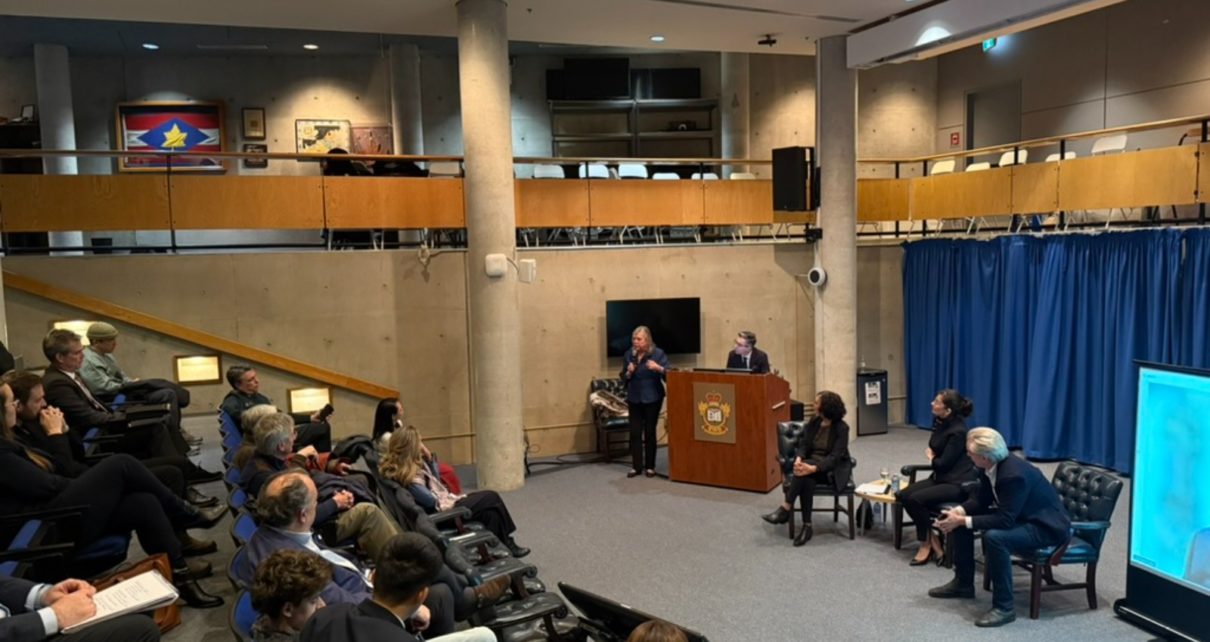
On November 25, 2025, the NATO Association of Canada (NAOC) and the Canadian International Council (CIC) Toronto Branch co-hosted a panel discussion at the Canadian Forces College on whether Canada should develop a modern civil defence corps. The event featured three guest speakers: Peter MacLeod, founder and principal of MASS LBP; Juliana Haras, a federal policy practitioner at the Centre for International and Defence Policy; and Dr. Andrew Burtch, an Adjunct Research Professor at Carleton University and a historian at the Canadian War Museum. Dr. Nirupama Agrawal of York University, a professor in Disaster and Emergency Management, moderated the discussion. The event was attended by over 50 participants and included a Q&A session and a post-event social.
The conversation opened with remarks from event organizers, who acknowledged the strength of the partnership between CIC Toronto and the NAOC. They emphasized the importance of public dialogue on national resilience and highlighted ongoing efforts to strengthen civic preparedness across Canada. One example of such an initiative is the NAOC project “Break the Blaze,” which uses gamified tools to improve wildfire readiness.
The panel began by examining the uncertainty shaping Canada’s security environment, driven by rising geopolitical tensions, foreign interference, and the climate crisis. Speakers noted that increased military activity, sophisticated information campaigns, and renewed strategic competition have weakened earlier assumptions that the post-Cold War order would remain stable. In response to these rising threats, many states have strengthened their civil defence programs. Speakers pointed to Nordic countries as examples of how governments engage the public in practical preparedness. For instance, Sweden trains citizens to recognize information threats and provides clear household guidance for emergencies, while Finland incorporates preparedness into schools and community organizations. Drawing on these approaches, speakers urged Canada to reassess its current model and consider how broader civic participation could support national readiness in both military and civilian settings.
The discussion then turned to grey zone challenges, in which state actors employ non-military tactics to influence societies without resorting to open conflict. These strategies include disinformation, election interference, and economic leverage aimed at shaping public attitudes while avoiding armed confrontation. The panelists agreed that countering such pressures requires coordinated societal effort. In this regard, Canada must strengthen its resilience by expanding digital and civic literacy in schools and by supporting community programs that build practical preparedness skills.
Speakers then reflected on Canada’s civil defence history. They pointed to the Cold War era, when civil defence programs depended heavily on local initiatives and community preparedness, including neighbourhood wardens, first-aid training, and public education campaigns. Clear instructional materials and regular drills kept awareness high, while Canadians volunteered readily as nuclear tensions made the danger feel immediate. The challenge was sustaining engagement once urgency faded, a difficulty that is even greater today as threats are less visible and develop gradually. Speakers also highlighted other practical constraints of creating a modern civil defence corps, stressing that countries often cited as models operate in different geographic and political settings. Any Canadian approach would need to account for population distribution, administrative complexity, and varied public expectations, and would require coordination across federal, provincial, municipal, and civil society actors.
During the question-and-answer period, the audience asked how Canada can strengthen civic responsibility, engage younger generations, and communicate national interests more effectively. Speakers emphasized that preparedness must begin early in life. They underscored the role of secondary education in fostering resilience, calling for curricula that include digital literacy, critical assessment of information ecosystems, and global security awareness.
The audience also asked how to govern a civil defence corps and sustain long-term participation. In response, speakers argued that any durable model would require predictable funding, clear national standards, and cooperation with organizations experienced in managing volunteer programs, such as the Red Cross. They added that digital tools can support public training and civic education, though online platforms must be designed carefully to reduce exposure to harmful content and foreign influence.
The event closed with remarks from the organizers, who underscored that Canada’s understanding of civil defence must evolve. With risks arising from climate threats, information manipulation, and shifting geopolitical alliances, national resilience will increasingly depend on citizens who understand these challenges and are prepared to respond to them.
Disclaimer: Any views or opinions expressed in articles are solely those of the authors and do not necessarily represent the views of the NATO Association of Canada.