*This is the fourth instalment of a six-part series.
Canada faces a number of challenges beyond those experienced by the Canadian Armed Forces that have further contributed to its inability to project sovereignty and security into the Canadian Arctic. These challenges have included: low Arctic population density, vast uninhabited areas, small remote settlements, and significant logistical hurdles for both civilian and military operations. Furthermore, given that the region suffers from inadequate military and civilian infrastructure, unforgiving weather, and a lack of skilled personnel to support any economic development, addressing these challenges has not been easy.
While strengthening sovereignty and security involves hard security measures, it also implies softer tactics such as regional economic development, environmental monitoring, and ensuring the long-term well-being of Northern residents and their communities. Canada’s ability (or lack thereof) to effectively project sovereignty and security in this regard has been exacerbated by severely limited transportation infrastructure in the Canadian Arctic. Road networks are minimal to nonexistent, while its airports are basic, often featuring runways unsuitable for jet aircraft. Seaports are also few and far between, provide limited shelter, and pose operational challenges due to strong currents, extreme tides, and a lack of pilot vessels. Moreover, many are too shallow to accommodate modern ocean-going ships. In fact, these infrastructure deficiencies have meant that Arctic logistics cost approximately four to five times more than those in lower latitudes.
Addressing these challenges has placed a heavy financial burden on both government and industry by taking up resources that could otherwise be used to stimulate regional economic growth. In fact, these high costs have historically led other Arctic nations to maintain limited security capabilities, resulting in “under-govern[ed] and under-secur[ed]” sovereignty—Canada being no different. Without a doubt, Canada’s Arctic has been held back by a vicious cycle of limited human and technological presence, which has been further constrained by a lack of substantial financial investment required to establish it, the latter of which is difficult to obtain without a significant human and technological presence.
To further complicate these physical challenges, Canada’s federal government has historically treated its northern territories as an afterthought, which is reflected in its relationship (or lack thereof) with the Inuit. As the prehistoric homeland of the Inuit, whose use of its bountiful resources was the basis upon which Canada claimed historical sovereignty and thus, modern sovereignty over its space, it is ironic that the federal government has long been unwilling to become full partners with the Yukon, the Northwest Territories, and Nunavut in Confederation (as provinces rather than mere territories). Specifically, given the prospect of untapped oil, gas, and valuable minerals, Nunavut has expressed on-going interest in obtaining the same powers and jurisdiction as the provinces over natural resources on Crown lands in Nunavut, as well as a joint resource utilization agreement with the federal government. These goals have been of primacy for the Government of Nunavut, which were bluntly reflected in comments made by Nunavut’s premier with respect to Arctic sovereignty in 2005:
“On the national stage we are treated more like a colony. The most blatant example of Nunavut being denied full partnership in confederation can be seen in the administration of our internal waterways. Provinces have the authority to manage this jurisdiction and collect royalties from resource development in this area. Yet Nunavut with the largest internal waterway in the country is denied these same rights and responsibilities. If Canada treats Nunavut like a colony or some “offshore” territory, is it any wonder that other countries do the same? As Inuit and Nunavummiut we share Canada’s international position that the arctic islands archipelago is an internal water way…It’s our presence in the North that gives Canada an unmatched expression of Northern sovereignty.”
Devolution Agreements between the federal government and the territories were finally signed, but only fairly recently (the Yukon signed in 2003, the Northwest Territories signed in 2014, and Nunavut signed in 2024). Notably, these agreements gave the territories more rights and responsibilities with respect to self-determination, especially regarding land and natural resource development.
With the onset of climate change, national borders and maritime Exclusive Economic Zones (EEZs) in the Arctic will also become increasingly porous. In fact, maritime security and safety challenges common to lower latitudes are expected to emerge as Arctic routes become increasingly accessible. As such, Canada will very soon be faced with having to project sovereignty and security into a space in which it is already deficient. The already limited presence of the Canadian Coast Guard and other law enforcement agencies in the Canadian Arctic will only lead to increased illegal activities such as trafficking, fishing, mineral extraction, as well as dangerous tourism activities – behaviours that are already difficult to monitor and regulate to begin with. Consequently, Canada is faced with the challenge of addressing the complex intersection of factors that continue to hinder its ability to assert both de jure and de facto sovereignty in the Arctic. This raises serious concerns about whether Canada can effectively manage and secure a region that it claims as its own through more than just legal arguments.
A New Partnership for the High North
Historically, Canada’s Arctic has been mostly uninhabited, not only due to its harsh environmental conditions, but also due to a lack of transportation connectivity with the rest of Canada. This remoteness has further contributed to the lack of community infrastructure in the North. Furthermore, while Canada has made some efforts to demonstrate effective sovereignty over its Arctic in the past, whether through RCMP stations or the physical relocation of Inuit residents, these efforts have been meagre at best. As the Arctic continues to open up and the warming climate enables more permanent settlements, Canada must take advantage of these changing environmental conditions to finally demonstrate full effective sovereignty over its Arctic.
Recent findings in a poll conducted in 2024 showed that Canadians expressed strong support for Arctic infrastructure, viewing it as both a strategic priority and a key component of nation-building, specifically with respect to water treatment plants, transportation infrastructure, and ports, with 42 percent identifying it as a matter of national significance. Survey respondents also indicated that the development of Arctic infrastructure should be prioritized over concerns about national autonomy, with a majority of Canadians expressing support for partnerships with other countries to facilitate infrastructure projects in the region. This sense of urgency extended to the federal government’s collaboration with private enterprises, with respondents strongly endorsing such partnerships to advance Arctic development. Moreover, according to Canada’s Inuit, “sovereignty begins at home,” such that they have also stressed that elevating the role of Northern residents is a key policy priority that can reinforce Canada’s historical and contemporary claims in the Arctic.
As such, Canada’s federal government must partner with its three northern territories to accelerate the development of their respective natural resource sectors through a Sovereign Arctic Investment Fund (SAIF), with an initial capitalization of C$5 billion to co-finance territorial and Indigenous-led industrial infrastructure projects critical to Arctic development and sovereignty. Canada will subsequently implement a suite of targeted economic incentives in order to stimulate sustainable population and infrastructure growth, thereby strengthening Canada’s effective sovereignty and hard security in the Arctic.
The SAIF would channel public capital into strategic infrastructure, resource development, and local capacity-building projects across the Canadian Arctic in order to catalyze economic activity (prioritizing critical minerals, hydrocarbons, and strategic materials), demonstrate effective sovereignty, and reinforce Canadian leadership in the North. The SAIF would be set up as a Crown corporation with a public-private advisory board that includes Arctic Indigenous representation. The initial funds would be re-appropriated from other parts of the federal budget, such as (but not limited to) the federal public service (which has grown by approximately 40 percent since 2015) and foreign aid. Canada spent approximately $12 billion CAD in foreign aid in 2023-2024 (2024-2025 figures are not yet available), so it is proposed that this budget be reduced through a re-assessment of foreign aid priorities and recipients. Moreover, a portion of future natural resource royalties would be earmarked to replenish and expand the fund, thereby creating a sustainable financial vehicle to support ongoing Arctic infrastructure and economic development.
This would enable the rise of a full-spectrum industrial complex similar to the Alberta oil sands, thereby stimulating demand for roads, ports, energy grids, and communications infrastructure. Such economic activity would catalyze the modernization of Arctic population centres, supporting secondary and tertiary industries, including construction, housing, education, health care, and tourism. Furthermore, to ensure legitimacy and local empowerment, Canada must co-develop this industrial complex with territorial governments and Indigenous groups, offering them equity stakes, regulatory influence, and shared revenue models. All of this development must also be designed with intentions for dual civilian-military use, such that not only would this increased Arctic presence be used to further demonstrate Canada’s effective sovereignty but also help maintain hard security in the High North. This access to natural resources will also help create a domestic supply chain for critical minerals that are important for various parts of Canada’s economy, such as (but not limited to) clean energy technologies, electric vehicle production, and defense technologies that will be crucial for Canada as it seeks to establish decreased economic and security reliance on the United States.
Concurrently, the Canadian government would offer tiered federal tax incentives in support of this new natural resource industrial complex to encourage the establishment of new businesses and population relocation to the Arctic. These incentives would be evaluated every 10 years to ensure policy relevance and success. For example, Canadians will be permitted to double the existing Northern Residents Deduction (which was designed to offset the higher cost of living and travel in remote and northern parts of Canada) for the first five years after relocation, as well as receive a housing tax credit for buying or building a house in the Arctic. Also, new businesses will pay no federal corporate tax for the first seven years of operating a qualifying business in a non-resource sector in the Arctic. Additional tax incentives would be provided for businesses that support sovereignty and security goals, such as providing job-related training for local Indigenous youth, building military/civilian dual use facilities, or serving strategic locations in the Arctic. Finally, all of these incentives would also be tied to geography, such that operating or moving to strategic locations in the Arctic would offer a larger incentive. As such, by leveraging public support, Indigenous partnership, and strategic infrastructure investment, this policy proposal would not only build resilient Arctic communities but also secure critical supply chains, diversify the economy, and affirm Canada’s place in an increasingly contested circumpolar world.
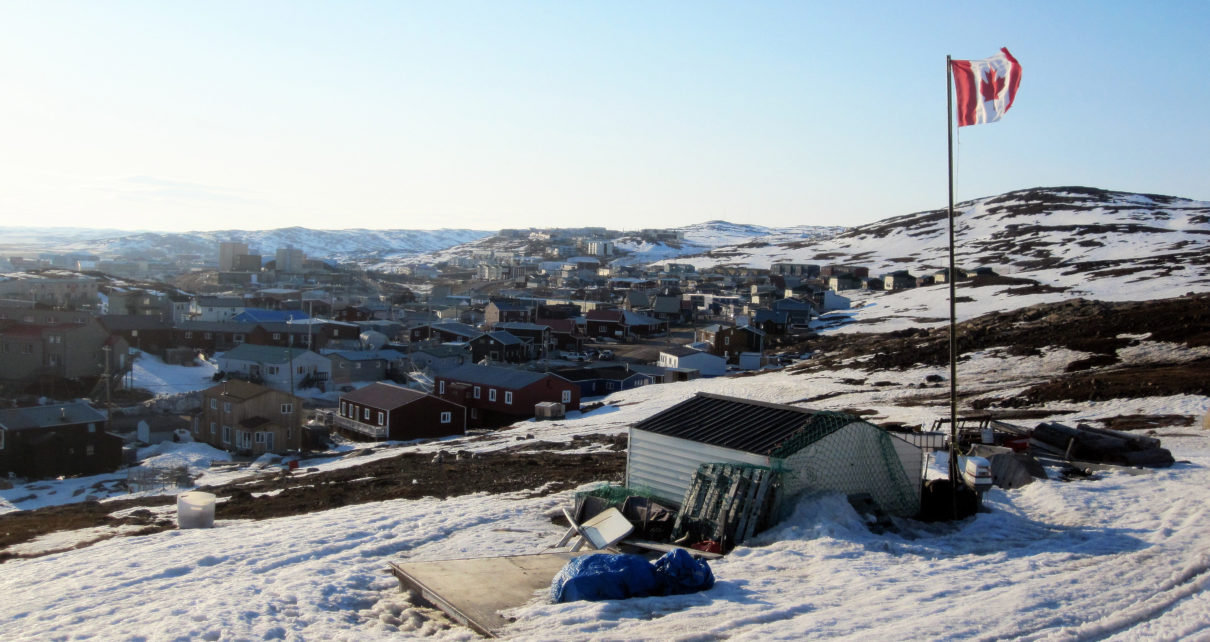
Cover photo: View of Iqaluit from Joamie Hill in Iqaluit, Nanuvut, Canada. Photo by Aaron M Lloyd.
Disclaimer: Any views or opinions expressed in articles are solely those of the authors and do not necessarily represent the views of the NATO Association of Canada.