Evolving Roles of Canada’s Navy and Coast Guard: Vice-Admiral (Ret’d) Peter Cairns
Posted onAuthorNATO Association of CanadaComments Off on Evolving Roles of Canada’s Navy and Coast Guard: Vice-Admiral (Ret’d) Peter Cairns
The NATO Council’s Maritime Security Conference – “From Sea to Sea: the Search for Maritime Security”
Evolving Roles of Canada’s Navy and Coast Guard: Vice-Admiral (Ret’d) Peter Cairns
Conference Coordinator: James Bridger
Media Director: Fatima Nanavati
Purpose: As a nation surrounded by three oceans and the great lakes, Canada’s maritime security has been of preeminent importance throughout the country’s history. A secure marine environment is also essential to Canada’s prosperity. Despite this marked significance, there has been recent concern that Canada has slipped into a state of “maritime blindness,” characterized by a general lack of awareness concerning issues of national and global oceanic security. This problem is particularly pronounced in central Canada, along the Toronto-Ottawa-Montreal corridor.
Seeking to address this weakness, The NATO Council of Canada (NCC) has taken a greater role in investigating and highlighting the strengths and weaknesses of Canadian maritime security and matters concerning our surrounding waters. Our goal is to raise public awareness about Canada’s most important frontier.
The mission of NATO Association of Canada is to promote peace, prosperity, and security through knowledge and understanding of the importance of NATO.
We strive to educate and engage Canadians about NATO and NATO’s goal of peace, prosperity and security. NATO Association of Canada ensures that we have an informed citizenry able to contribute to discussions about Canada’s role on the world stage.
As a leading member of the Atlantic Treaty Association (ATA), NATO Association of Canada has strong and enduring ties with sister organizations in many of the alliance countries, as well as members of NATO’s “Partnership for Peace” and “Mediterranean Dialogue” programmes. The NAOC has had a leading role in the recent transformation and modernization of the ATA, and helped to create and develop the Youth Atlantic Treaty Association (YATA).
The NAOC has strong ties with the Government of Canada including Global Affairs Canada and the Department of National Defence. We are constantly working to create and maintain relationships with international organizations such as the World Bank Group, the European Bank of Reconstruction and Development, NATO Headquarters, the International Criminal Court, and other prominent international NGOs and think tanks.
The mission of NATO Association of Canada is to promote peace, prosperity, and security through knowledge and understanding of the importance of NATO.
We strive to educate and engage Canadians about NATO and NATO’s goal of peace, prosperity and security. NATO Association of Canada ensures that we have an informed citizenry able to contribute to discussions about Canada’s role on the world stage.
As a leading member of the Atlantic Treaty Association (ATA), NATO Association of Canada has strong and enduring ties with sister organizations in many of the alliance countries, as well as members of NATO’s “Partnership for Peace” and “Mediterranean Dialogue” programmes. The NAOC has had a leading role in the recent transformation and modernization of the ATA, and helped to create and develop the Youth Atlantic Treaty Association (YATA).
The NAOC has strong ties with the Government of Canada including Global Affairs Canada and the Department of National Defence. We are constantly working to create and maintain relationships with international organizations such as the World Bank Group, the European Bank of Reconstruction and Development, NATO Headquarters, the International Criminal Court, and other prominent international NGOs and think tanks.
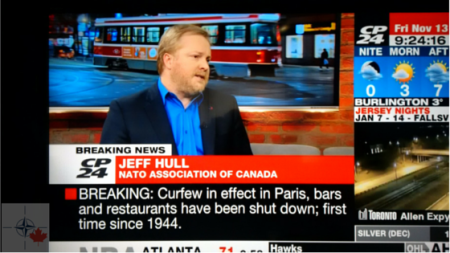
The NATO Association of Canada would like to highlight the media appearances of one of our Directors, Mr. Jeff Hull this past weekend. Mr. Hull spoke to CP24 in Toronto about the security implications of the terrorist attacks on November 13, 2015, in Paris and possible ripple effects in the global financial world. He additionally discussed Read More…
Hasan Siddiqui attempts to detail the various Kurdish groups across Turkey, Iraq, Syria and Iran; their interconnectivity, how they affect one another and the greater regional implication around them.