For much of the post-Cold War period, the relationship between economic policy and security policy within the transatlantic alliance was treated as complementary but distinct. Markets were expected to allocate resources, organize production, and deliver efficiency. Security institutions, by contrast, were expected to deter adversaries, manage military risk, and respond to external threats. That division of labour remained plausible so long as economic interdependence was widely understood as a source of stability rather than a source of leverage.
That assumption has become harder to sustain. The difficulty is not only that geopolitical tensions have intensified, but that the channels through which those tensions are experienced have changed. Supply chains can be disrupted, infrastructure can be targeted, and access to essential inputs can be restricted for political purposes. Under these conditions, decisions that once appeared primarily commercial increasingly carry security consequences. The boundary between economic policy and security policy has not disappeared, but it is no longer easy to maintain in practice.
It is in this context that Canadian Prime Minister Mark Carney’s recent remarks in Davos are best understood. PM Carney described an international environment in which resilience and stability are increasingly prioritized over strict adherence to inherited rules. His point was not that rules no longer matter, but that their function is changing under conditions of sustained disruption. Where predictability cannot be assumed, the capacity to absorb shocks becomes a central concern. This does not displace the rules-based order so much as reorder its objectives.
Energy systems make this shift visible. They are indispensable, capital-intensive, and slow to reconfigure. In sectors where adjustment is relatively cheap, governments can respond to strategic pressure with limited domestic consequences. Energy is different. A decision to change supplier, route, or infrastructure is rarely only strategic. It affects prices, industrial activity, and political tolerance for disruption. Once energy is treated as a security issue, the question is no longer only whether dependence creates vulnerability. It is how much disruption states are willing to bear in reducing it.
Convergence on Threat, Divergence on Risk
As energy systems move closer to the centre of security policy, NATO allies have converged on the fact that dependence can create vulnerability; it can be exploited through supply disruption, price manipulation, or political pressure. In that sense, disagreement over whether energy matters for security has narrowed, if not disappeared.
But convergence at the level of diagnosis does not produce convergence in response. Once dependence is recognized as a risk, the question becomes how far and how fast to act. It is here that divergence emerges. The central divide is not over threat perception, but over risk tolerance—specifically, how much economic disruption, price volatility, and domestic adjustment governments are prepared to accept in reducing exposure.
Measures intended to enhance resilience impose immediate costs. Diversification can raise prices. Infrastructure replacement requires investment. Controls on technology and supply chains can disrupt production. For some states, these costs are manageable. For others, they are more acute and more difficult to absorb. As a result, governments that share the same assessment of risk may still favour different timelines, instruments, and levels of ambition.
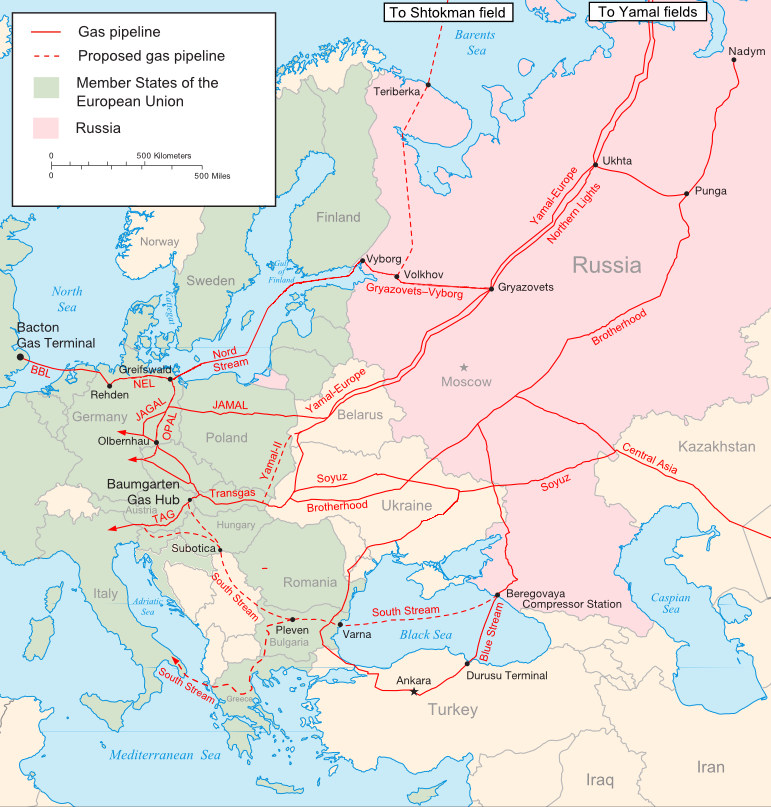
The European response to Russian energy dependence illustrates this dynamic. The European Commission now frames the phase-out of Russian energy imports explicitly as a security measure. Since the start of the war, the EU’s dependence on Russian gas has fallen sharply, and policy has shifted from short-term crisis management toward longer-term reduction. The underlying proposition has changed. Dependence is no longer treated as a neutral commercial fact. It is treated as a strategic condition to be managed and, where possible, reduced.
That shift, however, has not eliminated tension. Recent instability linked to the American-Israeli conflict with Iran, combined with persistent price pressures, has reintroduced the problem in a different form. Disruptions to global energy markets have increased costs and heightened uncertainty across Europe. In that context, some governments have begun to reconsider earlier decisions, including limited re-engagement with Russian energy.
This does not signal a return to the pre-2022 model. It reflects the constraints under which resilience policy operates. Reducing dependence imposes immediate and uneven costs. Maintaining it carries longer-term strategic risk. Governments are therefore managing a trade-off between two forms of vulnerability. The strategic logic of reducing exposure remains intact. What is less settled is how much cost can be sustained in pursuing it.
Seen in this light, the apparent inconsistency is not a reversal of principle. It is a reflection of differing risk thresholds. The lesson of the Russian case has not been displaced. It has become more difficult to operationalize under conditions of renewed market disruption.
These differences in risk tolerance are structured rather than arbitrary. Energy systems embed exposure through infrastructure, geography, and past investment decisions. Pipelines, grids, terminals, and supply chains create patterns of dependence that cannot be easily altered. Governments therefore operate within constraints that shape both their vulnerability and their policy options.
Some states have diversified supply, domestic production, or infrastructure that allows relatively quick adjustment. Others remain more tightly bound to specific suppliers or routes. These differences affect not only how disruption is experienced, but how it is evaluated. A government with greater fiscal capacity or supply flexibility can absorb higher costs. One without those buffers cannot.
Energy systems make these constraints visible because they translate strategic decisions into immediate economic effects. A shift in supplier is also a shift in price, infrastructure use, and market access. When such shifts are coordinated across an alliance, the distribution of cost becomes unavoidable. States that are less exposed may support faster or more ambitious measures. Those facing higher costs may favour gradual approaches or seek exemptions. The result is divergence in implementation, not necessarily disagreement over objectives.
This dynamic is particularly pronounced for middle powers. They operate within systems they do not fully control. They are integrated into global markets and infrastructure networks, but have limited ability to shape the rules that govern them. Their exposure is therefore determined not only by domestic choices, but by decisions taken elsewhere—by larger economies, dominant suppliers, and regulatory centres.
This is the sense in which the phrase “if you’re not at the table, you’re on the grid” applies. States that help shape rules can influence how risks are distributed. Those that do not must absorb outcomes they did not design. In energy systems, those outcomes are concrete: price changes, infrastructure constraints, and limits on available options.
For middle powers, this creates a persistent trade-off. Alignment with allies can provide security and access, but may impose disproportionate adjustment costs. Flexibility can reduce immediate exposure, but may limit influence over longer-term system design. Risk tolerance, in this context, reflects not only preference, but position within a broader system.
Canada and the Limits of Relative Advantage
Canada occupies a distinctive position within this landscape. As an energy producer with significant domestic resources, it is often less immediately exposed to the kinds of supply disruptions that affect import-dependent allies. This can create an appearance of insulation from the dynamics described above. In practice, however, Canada’s position reflects a different configuration of exposure rather than its absence.
Canada’s energy security is tied less to immediate supply risk and more to market access, infrastructure constraints, and external demand conditions. Its export capacity depends on pipelines, terminals, and regulatory approvals that are shaped by both domestic politics and external market dynamics. At the same time, Canada remains integrated into broader supply chains for technology, equipment, and capital, many of which are influenced by policy decisions taken in larger economies. As a result, Canada is not outside the system. It is embedded in it on terms that reflect both its resource base and its position as a middle power.
This creates a particular form of risk calculation. Canada may face fewer short-term supply disruptions than some European allies, but it is still exposed to shifts in global pricing, changes in regulatory standards, and decisions taken by partners that affect access to markets and infrastructure. For example, efforts by allies to restructure supply chains or impose new controls on energy-related technologies can affect Canadian producers and exporters even where domestic supply remains stable. Similarly, global price volatility driven by geopolitical events translates directly into domestic economic and political pressure.
In this context, Canada’s risk tolerance is shaped by a different set of trade-offs. It must balance the benefits of alignment with allied resilience strategies against the economic implications for its own energy sector and broader economy. Supporting diversification and security-oriented policies may reinforce Canada’s position within the alliance, but may also affect competitiveness, investment patterns, and infrastructure development. Conversely, prioritizing domestic economic considerations may preserve short-term stability while limiting influence over longer-term system design.
Canada’s position illustrates how even relatively advantaged states face constraints when energy systems are treated as strategic infrastructure. Its choices are not simply a matter of preference. They reflect its position within a system where key decisions, whether on markets, standards, or security priorities, are shaped collectively, but not always evenly.
Cohesion Under Constraint
These dynamics expose an institutional gap within NATO. The Alliance is well adapted to managing military risk. It can define threats, coordinate responses, and structure commitments. It is less well equipped to manage the distribution of economic and infrastructural risk among its members.
NATO increasingly recognizes the strategic importance of energy security and resilience. But recognition does not resolve distributional questions. The Alliance is not designed to allocate the costs of transition, compensate for uneven exposure, or reconcile different thresholds for acceptable disruption. Those issues are addressed through national policy, regional mechanisms, and ad hoc arrangements.
The result is a particular form of friction. Allies may agree on strategic objectives while diverging in implementation. Differences appear in timing, scope, and intensity rather than in stated goals. One state may delay. Another may narrow participation. A third may seek flexibility in application. These divergences are often incremental, but they accumulate.
The shift from rules to resilience makes this more likely. In a stable environment, shared rules can coordinate behaviour with limited attention to distributional effects. In a more fragmented environment, resilience requires active adjustment. That adjustment is costly and uneven. It forces governments to confront what can be sustained domestically.
Alliance cohesion, in this context, is unlikely to fail through open disagreement over objectives. It is more likely to erode through the accumulation of small divergences in practice. Each may be manageable on its own. Together, they can weaken coordination.
Energy systems make this dynamic visible because they combine strategic importance with material constraint. They cannot be adjusted without cost, and those costs are not evenly shared. As a result, disagreement over energy is often disagreement over risk allocation within the alliance.
The implication is not that allies no longer agree on the importance of energy security. It is that agreement at that level is no longer sufficient. What matters is how differences in risk tolerance are managed once the costs of acting on that agreement become clear.
For middle powers, this is the central challenge. They do not dispute the strategic importance of resilience. They experience its consequences directly. Their difficulty lies in navigating a system in which the need for adjustment is widely recognized, but the capacity to absorb its costs is unevenly distributed. In that setting, alliance cohesion depends not only on shared objectives, but on whether those differences can be managed without undermining collective action.