Adopted by the United Nations General Assembly in 1979, the Convention on the Elimination of All Forms of Discrimination against Women (CEDAW) is often called the global “bill of women’s rights.” It defines discrimination broadly and creates legal obligations for governments to address inequality in law, policy, and practice. CEDAW requires states to eliminate discriminatory laws, promote women’s participation in public life, and remove social and cultural barriers that limit equal opportunity.
Countries that ratify CEDAW must submit regular reports to the CEDAW Committee, which reviews progress and issues recommendations. However, this reporting system depends heavily on the cooperation and political will of states. There are no direct penalties for non-compliance, which limits the treaty’s enforcement. This challenge reflects a broader reality in international law: many human rights treaties establish legal duties but lack mechanisms to ensure they are upheld. In effect, compliance becomes uneven and largely dependent on national priorities.
Despite these limits, CEDAW remains a cornerstone of global gender equality efforts. Its value lies in setting shared legal norms that states can use to hold one another accountable, shaping expectations in both domestic and international policy.
NATO’s Women, Peace, and Security (WPS) agenda originated from United Nations Security Council Resolution 1325 (2000), which specifically finalized that women are recognized as key actors in conflict prevention, peace building and in the recovery stage, creating a shift away from the idea that women are only victims in a war. Subsequent resolutions articulated the need to focus not only on the protection from gender-based violence of women, but also on their participation in decision-making. This WPS agenda is anchored in four main principles: (1) Prevention, incorporating gender perspectives in operations that recognize and reduce harm to women/girls, (2) Protection, commitment to the safety of women in conflict situations, (3) Participation, involving women in peace and in leadership positions, and (4) Leadership, to encourage member states to elevate women to senior defence and diplomatic roles.
Although NATO’s WPS framework is promising, this framework is mainly as a political commitment instead of a legal obligation. The WPS agenda functions as a normative framework rather than a binding legal structure. The WPS agenda relies on voluntary compliance, cooperation, and partner commitment, as NATO encourages states to incorporate WPS frameworks into national policies in order to support implementations of the agenda. Ultimately, state action will depend on national choice. This voluntary application provides flexibility, but varying degrees of acceptance and action exist amongst member states. Some NATO member states have embraced principles of WPS into their security policies, while others view WPS principles as secondary to their larger strategies and military priorities. For example, the Atlantic Council notes how many have adopted National Action Plans, similar to Canada. However, other allies have an absence of political will and resources, such as a budget for implementation, to effectively incorporate these commitments.
CEDAW and NATO’s WPS agenda share the aim of gender equality in peace and governance, but employ different means. CEDAW imposes legally binding obligations, while NATO’s WPS agenda calls for voluntary political commitment within security and military efforts. These two find common ground in that law and policy can and often do complement each other, which shows not only legality but also action, both of which are necessary when it comes to meaningful gender progress. When CEDAW and NATO are aligned, CEDAW lends weight to the normative principles of the NATO agenda, and NATO gives CEDAW’s principles action, something that sustains women’s rights as a right and a strategic need.
However, both face the same barrier of adequate enforcement, given that the existence of monitoring frameworks that do not compel action will always depend on political will and fostering public accountability. Understanding and linking CEDAW’s monitoring process with NATO’s influence could further bolster compliance through legal, moral and reputational accountability. For Canada, this is an opportunity for leadership that converts commitments to action through accountability, showing once again that gender equality is key to both justice and everyday security.
Canada provides an important example of how a state can connect international legal obligations with alliance-based obligations. Being both a signatory to CEDAW and a member of NATO, Canada bridges the gap between complying with a legal obligation and providing political leadership. Through its National Action Plan (NAP) on Women, Peace, and Security, Canada is seeking to support women’s involvement in conflict prevention, peacebuilding, and humanitarian response.
Canada’s approaches linking NATO commitments with CEDAW obligations provide a practical model for linking global norms with domestic action. For example, CEDAW legally obliges Canada to ensure equality in political and public life. Meanwhile, NATO encourages and supports member states to have women’s involvement, along with gender perspectives across defence and security roles. Canada links the two by initiating PR conversations to integrate gender perspectives in foreign policy, peacekeeping training and defence planning.
This connection is not solely about supporting international commitments. There is also an element of advancing Canada’s strategic interests. A strong commitment to women’s rights and issues reinforces Canada’s image as a middle power that prioritizes human security and multilateralism. This reinforces diplomatic credibility in NATO and with the UN. It also hedges Canada’s wider foreign policy projection of being a defender of democratic values.
Furthermore, gender equity and equality considerations benefit operational effectiveness in security environments. For instance, research demonstrates that when women are included in peace agreements, they are more likely to be durable. In addition, diverse leadership structures encourage better decision-making in complex operating environments, characterized by conflict. For Canada, the articulation of gender perspectives supports mission effectiveness and advances Canada’s larger goal of supporting inclusive, stable societies internationally.
Moreover, Canada has practical reasons to care about connecting CEDAW and WPS. As global conflict becomes increasingly complex and diverse, including cyberwarfare and climate-related insecurity, human rights and gender perspectives have become centerpiece issues of security governance. To ignore these proportions would risk discrediting the legitimacy of NATO and Canada’s position within NATO. Supporting women’s full participation is not merely a moral or symbolic opportunity for Canada, but rather part of its credibility and leadership globally.
By combining CEDAW with NATO’s WPS agenda, we can see how legal norms and political commitments can strengthen one another. CEDAW weakens rights, and NATO provides the operational context for those rights. Together, they offer the opportunity to make gender equality more than a rhetorical target. It is a necessary element for effective security governance.
Yet, there remains a gap between law and practical application. Establishing binding gender equality standards within NATO would take a consensus across the membership of the alliance, which is politically complex. However, alternative pathways exist for achieving the same goals. By establishing reporting protocols to members like CEDAW does, implementing peer review, or framing funding around progress, greater accountability on implementation can be achieved.
At a time of accelerating global tensions and shifting global power structures, advancing women’s equality in peace and security is a test of NATO’s adaptability to new realities. For Canada, it is a test of whether consistency in recognition of its fundamental human rights principles can translate into actual measurable outcomes in our defence, diplomacy, and development practices.
At the end of the day, advancing CEDAW in alignment with the WPS agenda is not simply about enhancing a gender agenda based on policy; it’s about strengthening peace itself. Societies that support women are more resilient, more democratic, and more stable. Canada’s support for these agendas represents an investment in the international order it advocates, anchored in equality, collective action, and adherence to legal principles.
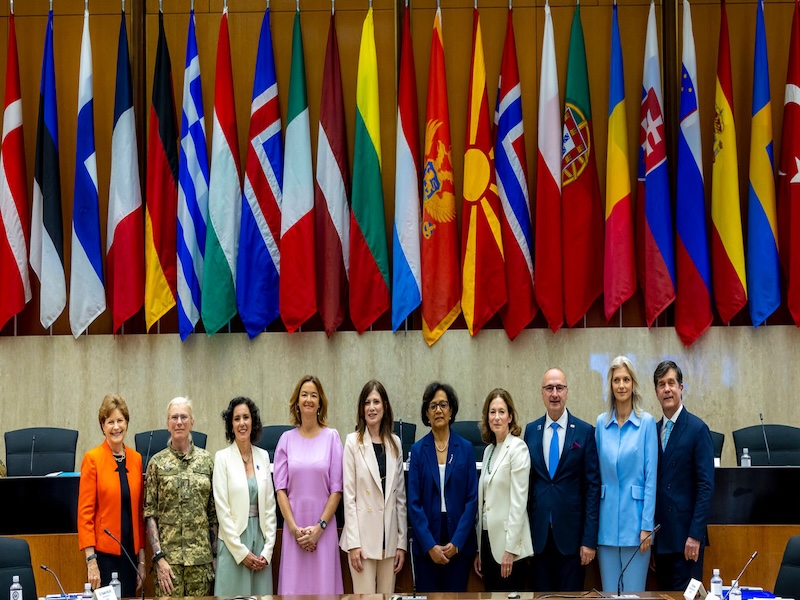
Photo: Allies endorse a new NATO Policy on Women, Peace and Security at the Summit in Washington. 2024. Accessed via NATO HQ.
Disclaimer: Any views or opinions expressed in articles are solely those of the authors and do not necessarily represent the views of the NATO Association of Canada.