Canada and the United States have always maintained one of the world’s most integrated trading relationships, with businesses and industries on both sides of the border relying on cross-border supply chains. This relationship has come under increasing pressure as the United States and Canada have imposed tariffs and countermeasures on one another. For instance, in August 2026, the United States imposed a 50 per cent tariff on $27.6 billion worth of Canadian goods, which prompted Canada to introduce matching counter-tariffs dollar for dollar.
Given the deep integration of U.S.-Canada trade and production, these tensions have raised concerns about the resilience of critical supply chains, including the distribution of pharmaceutical inputs and medicine. Thus, any changes in trade policy risk creating vulnerabilities beyond economic loss. Overall, the deterioration of the U.S.-Canada relations demonstrates that economic interdependence between allies can become a health-security vulnerability during periods of geopolitical tension. As trade restrictions continue to challenge deeply integrated supply chains, Canada and the United States should treat health security as an element of resilience by strengthening domestic capacity and diversifying critical medical supply chains.
How Economic Interdependence Creates Health-Security Vulnerabilities
The relationship between both nations goes beyond geography and history, but is also tied by extensive trade and investment flows and cross-border supply chains. The United States is Canada’s largest trading partner in goods and services, while Canada is the United States’ second-largest trading partner. Almost $2.6 billion worth of goods and services crossed the border daily in 2024. More specifically, Canada and the U.S. have a substantial and highly interconnected pharmaceutical trade relationship. In 2025, the U.S. accounted for 70.4% of Canadian pharmaceutical exports and 32.4% of imports. Given the recent economic tensions between the two, this level of interdependence creates vulnerabilities for both economies as tariffs and other trade restrictions could disrupt access to essential products and create cross-border policy uncertainty.
Canada relies heavily on pharmaceutical imports, with 56% of finished generic drugs imported during 2019–2021. Generic drugs contain the same active pharmaceutical ingredients (APIs) as their brand-name counterparts. The U.S. Food and Drug Administration (FDA) defines APIs as substances responsible for producing a drug’s intended therapeutic effect.
However, domestic pharmaceutical manufacturing does not eliminate Canada’s reliance on foreign inputs, including imported APIs and raw materials. According to a 2022 study by EY Canada for the Canadian Generic Pharmaceutical Association, Canada relies on trade relationships with India, the United States, and Europe to secure APIs and finished-dose products.
This dependence on international supply chains means that Canada’s pharmaceutical security does not rely solely on its domestic manufacturing capacity. Disruptions to trade, transportation, or access to foreign inputs could affect both the availability of imported medicines and Canada’s ability to manufacture medicines domestically.
Resilience Does Not Mean Self-Sufficiency
While foreign dependence on trade has revealed the potential vulnerabilities that Canada can face, the country cannot combat this by manufacturing every pharmaceutical product domestically. This would be unrealistic given the size of the Canadian pharmaceutical market which represents about 2% of global drug and medical device sales. API manufacturing is largely outsourced even if the final manufacturing of a drug might be done in Canada. Most pharmaceutical companies purchase APIs internationally according to Health Canada. Therefore, rather than pharmaceutical self sufficiency, Canada must prioritize strategic domestic capacity.
Strategic domestic capacity must be strengthened specifically in areas where disruptions can pose the greatest risk to public health. For instance, Health Canada provides a list of medicines that are already vulnerable to supply disruptions. Antibiotics including amoxicillin and penicillin G are useful examples of drugs that are critical and vulnerable to shortages. Strengthening domestic production of certain medicines or their key inputs would provide Canada with greater resilience when international trade or transportation is disrupted, without requiring the country to produce every medicine domestically.
In fact, Canada is already taking steps to strengthen domestic capacity and bolster health security. The early start of the COVID-19 pandemic demonstrated the importance of a resilient biopharmaceutical industry, as Canada lacked the flexible biomanufacturing capacity needed to quickly produce a COVID-19 vaccine domestically. As a result, the federal government has been working on rebuilding the domestic biomanufacturing sector through quick strategic actions as well as maintaining a long-term vision to develop sustainable domestic vaccine and therapeutics manufacturing capacity.Budget 2021 has put $2.2 billion to implement the Biomanufacturing and Life Sciences Strategy.
The strategy focuses on strengthening the research and talent base of Canadian businesses and projects that address gaps in the biomanufacturing supply chain. These investments aim to build a stronger domestic life sciences sector and reduce vulnerabilities in Canada’s health supply chains during future health security emergencies. While these are important steps toward reducing Canada’s vulnerability to external disruptions, they cannot, on their own, eliminate the country’s dependence on international pharmaceutical supply chains. Canada must also diversify its pharmaceutical supply chains.
Diversification: From Dependence to Resilient Interdependence
Canada is highly reliant on foreign pharmaceutical supply chains. However, the issue is not necessarily foreign dependence, but dependence on a small or limited number of suppliers. Imports increased from 74% to 93% of total domestic drug expenditures over the past decade, highlighting Canada’s exposure to external supply disruptions. If a critical medicine or active pharmaceutical ingredient (API) comes predominantly from one country and production, transportation, or trade is disrupted there, Canada may have fewer alternative suppliers to turn to for that medicine or API.
Rather than relying on a single foreign source for a critical medicine or its API, Canada could establish multiple qualified suppliers across different countries while maintaining domestic production capacity for strategically important medicines. The Pharmaceutical and Life Sciences Sector Task Force recommends developing partnerships with trusted countries to support more resilient and diversified sourcing of pharmaceuticals. Although maintaining multiple suppliers can increase procurement costs, it can also reduce the risk of shortages caused by disruptions affecting a single source.
Diversifying supply chains does not mean abandoning the United States or the bilateral pharmaceutical ties Canada has developed with it. Canada can still maintain North American pharmaceutical cooperation while developing alternative sources for critical products and inputs. This would allow Canada to benefit from existing U.S. partnerships while reducing its exposure to disruptions affecting any single supplier or market.
What This Means for NATO and Allied Health Security
NATO already considers resilience and civil preparedness as part of collective security. Health systems and critical supply chains are part of that resilience, considering that pharmaceutical supply disruptions can significantly affect civilians, military readiness, and crisis response. NATO’s 2026 Resilience Baseline Requirements call on Allies to strengthen preparedness for disruptive health crises, ensure essential healthcare services for civilian populations and military forces, and establish robust and diversified security-of-supply arrangements for medical supplies, pharmaceuticals, and active pharmaceutical ingredients.
This becomes quite relevant as geopolitical tensions begin to unfold exposing the vulnerabilities created by economic dependence. During times of conflict, NATO acknowledges the limitations that strategic dependencies can cause to supply chains and crisis response. Furthermore, the alliance also emphasizes the potential for disruptions in one area to produce cascading effects across others. Therefore, disruptions to pharmaceutical supply chains should be looked at as part of civilian preparedness and military resilience rather than merely a health-sector response.
For Canada and its NATO Allies, this means building health-security resilience around diversification, contingency planning, and strategic capacity rather than assuming that existing economic relationships will remain stable during a crisis. Strengthening domestic capabilities while diversifying sources of critical medicines and active pharmaceutical ingredients could help allies reduce exposure to geopolitical disruptions while preserving the benefits of allied economic cooperation.
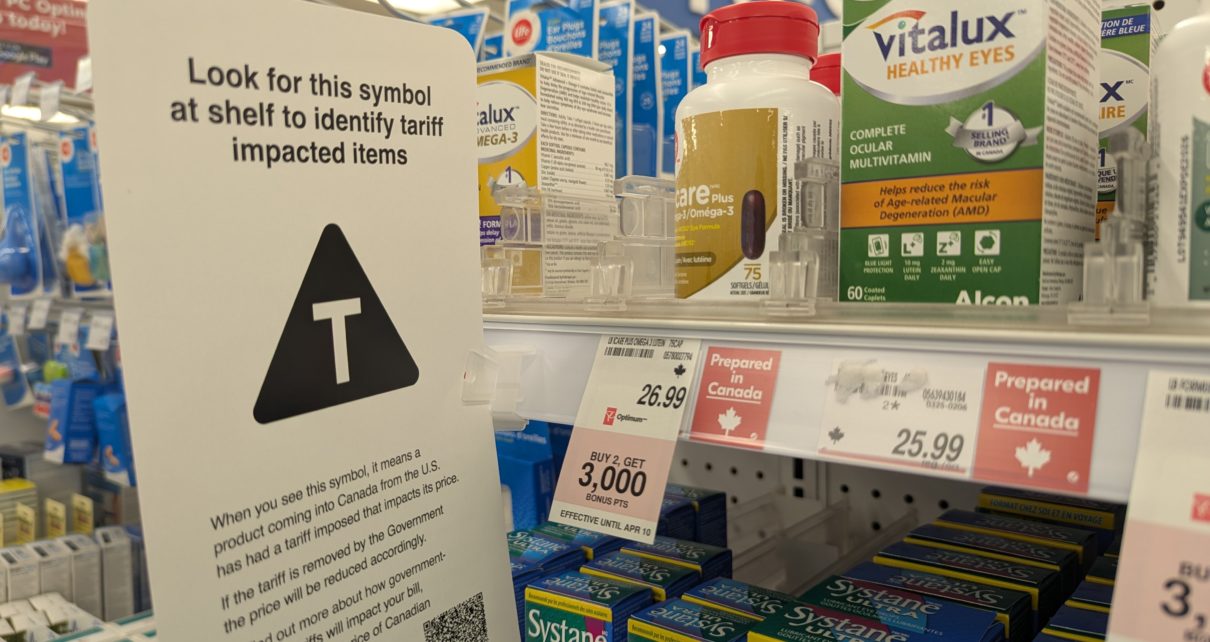
Photo: Tariff imposition warning at Shoppers Drug Mart in Canada (5 April 2025), by Sikander Iqbal via Wikimedia Commons. Licensed under CC BY-SA 4.0.