In 2024, Canada reported its costliest year on record for extreme weather insurance claims, with each year from 2020 to 2025 ranked among the top ten. As climate change worsens, extreme weather events are becoming increasingly common and harder for buildings to endure. Coastal flooding, storm surges, and extreme rainfall threaten infrastructure, and the cost to repair the damage is likely to rise over time. As outlined in NATO’s climate change and security action plan, climate change is seen as a threat multiplier that is likely to test the resilience of its members’ critical infrastructure. Of particular concern to Canada’s military readiness are its shipyards, which are especially vulnerable to flooding because they are built at sea level. Without improved and expanded sea barriers to redirect most of the impact, the risk of damage could rise to unacceptable levels at a time when Canada is investing immense resources in modernizing its navy. Halifax Harbour, where Canada has recently begun building its new River-class destroyers, is expected to experience a relative sea level rise higher than the global average, making it an especially vulnerable site over the coming decades. On the other side of the country in Vancouver, where work on Canada’s largest-ever icebreaker is well underway, the existing dikes in and around the city are not designed to accommodate heightened sea levels.
For shipyards such as these, even minor delays can lead to increases in cost and leave Canada’s navy waiting for far longer than it’s expecting, as lost working hours from unsafe conditions caused by flooding can force back ship delivery schedules. Delays and cost overruns are no new challenge for the Canadian navy, and any further pressure on the shipbuilding industry risks stretching Canada’s military budget even thinner. To help mitigate the risk of compounding damage and delays in the future, the Canadian government should consider directing part of its defence-related infrastructure spending towards hardening shipyards against flooding.
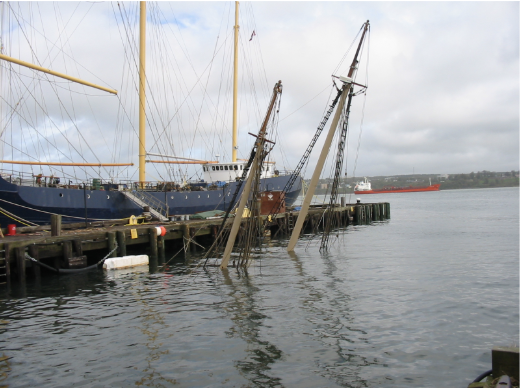
Although climate change threatens practically every form of infrastructure, the low elevation of shipyards and the need for direct access to water leave them especially vulnerable to coastal flooding and storm surges. Intense flooding is rare in Canada, but incidents such as 2003’s Hurricane Juan, where storm surges as high as 1.5-2 metres caused considerable damage to Halifax’s waterfront, serve as a stark reminder of the damage severe coastal flooding can cause to waterfront infrastructure. As recently as September 5, 2026, heavy rainfall forced various counties in Cape Breton to declare a state of emergency due to the severity of the damage, as winds and flooding damaged infrastructure and caused widespread power outages.
Climate-induced damage to shipyards is rare, but certainly not without precedent. Looking south, Norfolk Naval Shipyard, one of America’s most important, faced nine major floods in ten years from 2008-2018, with damage to ship repair equipment reported. In a more recent case halfway across the world early this August, extreme rainfall temporarily shut down South Korea’s Geoje shipyards as the flooded roads made the yards inaccessible. These cases are an early warning that Canada would be wise to act on.
Beyond budgetary strain, shipyard delays can have strategic implications for both Canada and NATO as a whole. Naval power is a critical component of collective defence, and Canada plays a key role in ensuring NATO has the right ships for the job. In particular, Canada specializes in its icebreakers, possessing the largest icebreaker fleet in NATO and one of the largest in the world, with new and highly capable ships currently under construction. These ships occupy a crucial capability role in NATO’s broader naval composition as they keep shipping lanes open for other naval vessels to transit. Without enough icebreakers being built and maintained, NATO’s ability to safely transit the Arctic could be impaired.
The importance of these ships is heightened as global powers race to construct their own icebreaking fleets, as climate change makes passage through and around the Arctic increasingly viable. NATO has increased its focus on Arctic security in recent years, making Canada’s shipbuilding capability crucial. If Canada fails to ensure its ships can be constructed in a reasonable timeframe, it runs the risk of ceding Arctic capability to its rivals. Many NATO members produce large quantities of planes, tanks, or ammunition. However, icebreakers are only built in any meaningful number by a select few. If Canada fails to protect its shipyards from flooding, the ramifications may affect the entire alliance.
While some damage from intense flooding is often unavoidable, there are a handful of measures Canada can take that can significantly mitigate how long shipyard delays have to last. One option is to expand local wetlands near its coasts, as they can help absorb and disperse the force of flooding. Using local ecosystems to mitigate flooding is an attractive tactic due to being far cheaper than manmade barriers, although its usage can be limited in dense cities where structures already take up most of the room near the coast. This limits its feasibility as a standalone solution for most of Canada’s major shipyards, but even smaller-scale natural barriers can have a significant impact, making it viable as a complementary piece. Expanding coastal wetlands has the added benefit of providing broader protection along the coast, potentially helping to reduce flooding beyond the boundaries of the shipyards.
Another possible route may be changing how Canada spends its existing defence budget, as Canada slowly ramps up to 5 percent of gross domestic product (GDP) spent on defence and security-related spending. Under the recent Hague Summit Declaration, as much as 1.5 percent of Canada’s GDP can be allocated to broader security investments and be counted towards the 5 percent goal, which can include protecting critical infrastructure. Protecting shipyards would be an effective use of this budget, meaning that shifting priorities, not necessarily increasing the budget, should be enough to address the problem. A portion of this money can be redirected to augment or subsidize existing corporate plans to build barriers or raise critical infrastructure above sea level, easing pressure on shipyards. While leaving these investments to the private sector may otherwise be reasonable, the potential damage to Canada’s military readiness if its newly ordered ships are delayed warrants extra support. By bearing some of the costs, Canada can keep its shipyards at full capacity in the years to come while working towards meeting its spending obligations to NATO.
It’s often difficult to set aside funding for things that will reap benefits in the future, when the current situation seems stable. However, Canada needs to take the implications of a deteriorating climate seriously. If it’s willing to set aside some money and effort to prepare its shipyards to operate in a higher-risk environment, Canadian shipbuilding can continue to approach its full potential at a time when new ships are critically needed. The coming years will see Canada face difficult decisions on where to prioritize its budget, but despite the upfront costs and delayed returns, investing in Canada’s shipyard hardening could prove cost-effective. When given the choice between protecting a site and rebuilding it, taking the upfront cost will often be far cheaper.
Cover Photo: “A sunken ship on the Halifax Waterfront after Hurricane Juan” (n.d.), by Figure8 via Wikimedia Commons. Licensed under CC BY-SA 3.0
Disclaimer: Any views or opinions expressed in articles are solely those of the authors and do not necessarily represent the views of the NATO Association of Canada.