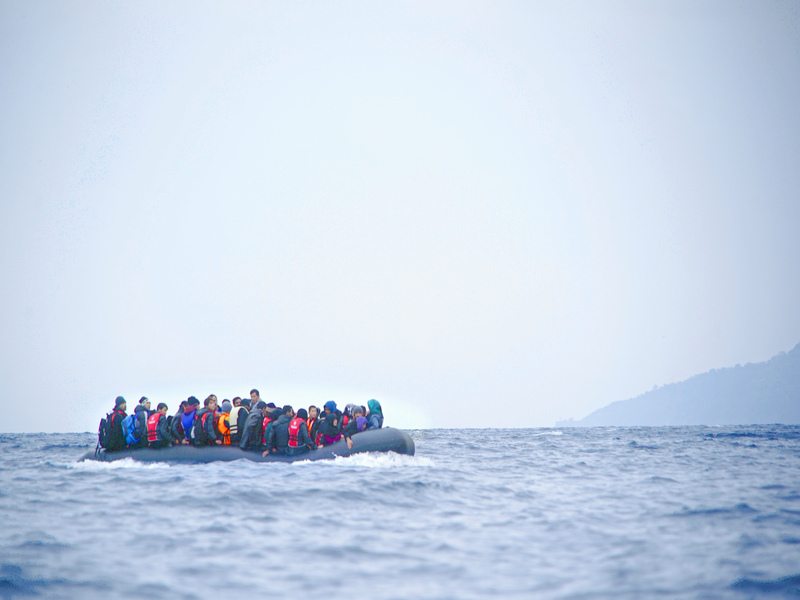
In the waters of the Mediterranean, a severe humanitarian crisis is unfolding in near-total silence. Human smuggling networks actively exploit unmonitored maritime zones by deploying transponder-less ghost boats. Migrants from North Africa, the Middle East, and South Asia pay thousands of dollars per ticket only to be pushed onto unequipped, one-way crafts intentionally stripped of radios and transponders to evade coast guard detection.
Since these overpacked vessels operate completely off the grid, they frequently capsize and sink without ever sending a distress call or leaving a digital footprint, resulting in what are known as ‘invisible shipwrecks.’ For the thousands of vulnerable migrants risking their lives on these routes, this physical peril is severely compounded by a systemic reporting vacuum and electronic deception that erases vessels from the digital map.
This leaves humanitarian actors in the dark, denying vulnerable people the protection of basic maritime law and leaving families of the missing in a permanent state of unresolved grief.
At the same time, this issue compromises NATO’s Operation Sea Guardian, which is tasked with ensuring security and navigational freedom in the region. By leveraging its advanced space-based technology, Canada can contribute to the protection of human rights by helping NATO forces ensure that those lost in the Mediterranean are no longer left to vanish in silence.
Issue Background
The Mediterranean has emerged as the epicenter of this maritime blindness, where ‘invisible shipwrecks’ have surged dramatically. The International Organization for Migration (IOM) notes that alongside nearly 7900 known and documented deaths in 2025, an estimated 1500 additional individuals vanished at sea as unverified fatalities due to limited access to maritime tracking data.
In addition, during severe weather anomalies like Cyclone Harry where regional authorities did not release official departure data, over 1000 people vanished from coastal zones without a single official confirmation, public record, or coordinated search effort.
According to data compiled by the IOM’s Missing Migrants Project, 35,074 migrants have been recorded as missing since 2014, with 1414 lost in 2026 alone, while European routes account for at least 16,032 individuals whose remains have never been recovered. For these left-behind populations, the systematic refusal of states to log rescues or provide coordinates initiates a devastating “trauma of stasis.” Unlike a verified death, which despite its tragedy, allows for traditional cultural mourning and eventual closure, a disappearance traps families in a state of psychological paralysis that freezes household decision-making, halts local economic activity, and permanently disrupts the demographic and social fabric of entire regions.
The maladministering of Cyclone Harry illustrates how information vacuums are exacerbated by a “strategy of silence” that suppresses operational visibility by drastically scaling back transparent rescue reporting and restricting civilian search-and-rescue (SAR) efforts.
The lack of open, timely reporting on maritime emergencies directly worsens the humanitarian crisis at sea. When frontline states fail to quickly share or reconcile records of sea departures and distress signals, they create a deadly information vacuum that prevents rescue teams from knowing where and when help is needed, transforming preventable accidents into unavoidable tragedies.
As highlighted by the International Committee of the Red Cross (ICRC), when a primary breadwinner goes missing, the family left behind almost immediately falls into severe financial difficulty. Compounding this financial distress is the reality that missing status rarely carries legal weight, leaving these families in a legal void that strips them of basic rights without proof of their loved one’s death. This legal vacuum freezes joint assets and inheritances while blocking access to spousal support, property ownership, child guardianship, and even the right to remarry. By withholding maritime coordinates and hiding the fate of these vessels, states are exporting a structural engine of legal non-existence and psychological torment that paralyzes entire communities across the globe.
Far from just a series of isolated tragedies at sea, this localized erasure aggregates into a profound, population-level threat that structurally destabilizes the home societies left behind. When thousands of individuals, predominantly young, economically active breadwinners, vanish into a reporting void, they leave behind an estimated 340,000 family members worldwide who are thrust into immediate socio-economic and legal paralysis.
Operational Challenges
Yet, this structural crisis is actively accelerated by deliberate digital deception on the water. To slip past regional authorities, smuggling networks and illicit vessels systematically turn off or manipulate their Automatic Identification System (AIS) transponders, the digital beacons that broadcast a ship’s identity, speed, and location. By turning their transponders off to go ‘dark,’ or broadcasting entirely fake coordinates (a practice known as AIS spoofing), these vessels completely erase themselves from the digital maps used by rescue crews and international security forces.
Civilian rescue networks and security patrols are forced to search for distressed vessels using a map that is being actively forged by the smugglers themselves. This electronic chaos directly paralyzes emergency responses, allowing overcrowded boats to vanish into thin air and leaving NATO’s southern flank dangerously exposed to unmonitored human trafficking networks.
The combination of fragmented data reporting and electronic spoofing directly compromises NATO’s Operation Sea Guardian – the Alliance’s flagship maritime security operation tasked with maintaining freedom of navigation, countering terrorism, and ensuring southern European stability. Operation Sea Guardian relies fundamentally on a reliable, real-time Recognized Maritime Picture to ensure the safety of transit lanes. However, when the digital map is intentionally cluttered with forged data, civil society bears the highest cost. A security architecture that is rendered tactically blind cannot effectively guarantee the safety of international waters. This breakdown in visibility transforms shared maritime spaces into lawless corridors, severely undermining the collective deterrence and human security commitments necessary to protect democratic societies.
Solutions Canada Can Provide
To effectively dismantle this enforced invisibility, maritime security efforts need three basic tools: satellites that can track vessels at night and through heavy storms, smart software that immediately flags hidden ships, and fast data connections to send that information straight to rescue teams. Instead of relying on boats to report their own locations voluntarily, authorities need space-based sensors that can physically spot hidden crafts in open waters and give rescue crews the live data they need to act.
Canada can contribute to existing efforts to counter this enforced invisibility by leveraging its existing space assets. The cornerstone of this capability is the RADARSAT Constellation Mission (RCM). While standard satellite imagery is ineffective at night, when trafficking rings prefer to operate, Canada’s Synthetic Aperture Radar (SAR) technology pierces through storms and darkness to physically detect vessels based on their metallic hulls, regardless of whether their location transponders have been intentionally disabled or spoofed.
To translate this data into actionable humanitarian and maritime intelligence, Canada can deploy its Dark Vessel Detection (DVD) platform. By using machine learning to cross-reference physical radar targets against broadcast digital data, the DVD system immediately flags a vessel if it possesses a physical hull mass but no corresponding digital signature. A ghost boat can disable its electronics to evade oversight, but it cannot shrink its physical mass to escape a radar eye in space. As a result, Canadian innovation is an indispensable tool for stripping away the anonymity of illicit actors, protecting vulnerable lives, and upholding international law across the Mediterranean.
To operationalize this solution, Canada should establish a direct data-streaming pipeline from RADARSAT straight to NATO’s Allied Maritime Command (MARCOM) in the UK and the NATO Maritime Interdiction Operational Training Centre (NMIOTC) in Greece. Since these hubs specialize in countering regional human trafficking, this direct pipeline empowers frontline units to intercept unmonitored ghost boats before they lead to mass casualties, bypassing administrative reporting gaps to restore transparency to shared transit lanes.
NATO’s greatest vulnerability in the Mediterranean is a lack of reliable data. By hardwiring its RADARSAT infrastructure into NATO’s commands, Canada could help reduce critical maritime surveillance gaps that place thousands of lives at risk year after year. Canadian technology can help preserve human life in the world’s most vulnerable maritime spaces.
Image credit: Refugees on a boat crossing the Mediterranean Sea (2016) by Mstyslav Chernov via Wikimedia Commons. Licensed under CC A 4.0.
Disclaimer: Any views or opinions expressed in articles are solely those of the authors and do not necessarily represent the views of the NATO Association of Canada.