The warming Arctic is one of the greatest sources of vulnerability for Canadian security and defence, and yet the communities best positioned to generate the knowledge required to protect it are functionally absent from NATO’s plan, reflecting a profound intelligence gap. For generations, Inuit hunters, harvesters, and land stewards across the Canadian North have accumulated a robust body of knowledge about the Arctic landscape and its ecosystems. From centuries of tracking shifts in sea ice and the timing of seasons to monitoring the health of marine animals and coastal ecosystems, Northern Indigenous populations arguably possess some of the world’s most detailed long-baseline environmental intelligence about the Arctic.
This intelligence gap is striking given NATO’s consistent and growing institutional commitment to climate security. NATO formally recognized climate change as a security threat in its 2021 Climate Change and Security Action Plan (CCSAP), and in 2024, Canada took a further step by establishing and hosting NATO’s new Climate Change and Security Centre of Excellence (CCASCOE) in Montreal. Vulnerabilities in the Arctic are among the central concerns driving such initiatives, as climate change effects such as permafrost thaw, coastal erosion, and flooding place growing strains on Arctic defence infrastructure and military operations. Experts warn of growing geopolitical risks should the federal government fail to invest in Arctic security, as foreign Nations will likely take advantage of these vulnerabilities.
The institutional infrastructure to strengthen NATO’s arctic climate security is firmly in place, but is NATO drawing on the best intelligence to use it? This article argues that integrating Indigenous, community-led environmental monitoring into NATO’s climate security architecture is not a symbolic gesture towards reconciliation, but a practical intelligence imperative. Indigenous communities are ready and eager to participate, and the CCASCOE offers a concrete institutional channel through which to begin. The article also examines the structural barriers that have so far prevented meaningful collaboration and proposes concrete steps towards filling the gap.
The Arctic Intelligence Gap
NATO’s 2024 Climate Change and Security Impact Assessment reveals significant intelligence and surveillance gaps for Arctic climate security. The report explicitly acknowledges that the region suffers from “limited radar and satellite coverage” and “climate blind spots” that compromise global climate forecasting and carry direct security consequences. The assessment itself draws primarily on global climate models, satellite data, and infrastructure vulnerability assessments to evaluate climate risks to Allied security. Yet it makes no mention of the detailed, place-based, community-driven forms of environmental knowledge and data that Indigenous peoples across Canada’s North have been accumulating for generations, and that would help fill those blind spots.
Indigenous-led environmental monitoring is a form of community-based monitoring that involves detection and analysis of environmental change carried out by and for local Indigenous communities. Monitoring methods draw on traditional, and yet dynamic and evolving, Indigenous knowledge and practices involving resource use, stewardship, oral histories, and relational ethics. In practice, they encompass a wide range of activities, from standard scientific field monitoring or harvest specimen analysis to harvest self-reports and participatory mapping.
The intelligence advantages of Indigenous-led environmental monitoring are well documented, yet underappreciated in security contexts. Indigenous knowledge often provides valuable insights that complement, and expand significantly on, those generated by Western scientific processes. As a compelling example, the Inuit possess Canada’s most detailed climatological history of sea ice, a record built through centuries of intimate, place-based environmental observation and transmitted through traditional Inuit knowledge systems. Research shows that this record has effectively filled knowledge gaps about Arctic sea ice conditions that even the IPCC’s assessments cannot address, given that top-down monitoring approaches are not designed to capture the local-scale changes and adaptive needs of Arctic communities. This intelligence has clear defence advantages, as sea ice conditions directly affect Arctic navigation and the operational environment for Allied forces in the High North.
More broadly, research consistently shows that when Indigenous communities lead their own monitoring programs, they track a more diverse set of indicators than externally driven scientific programs do. Where conventional monitoring tends to focus on discrete ecological measurements, Indigenous-led programs integrate ecological, social, and cultural indicators simultaneously, resulting in adaptative responses that are better able to address a complex set of security risks for Arctic communities themselves, and producing exactly the kind of ground-level environmental intelligence that NATO’s top-down frameworks currently miss.
Indigenous Communities Are Ready, But Barriers Remain
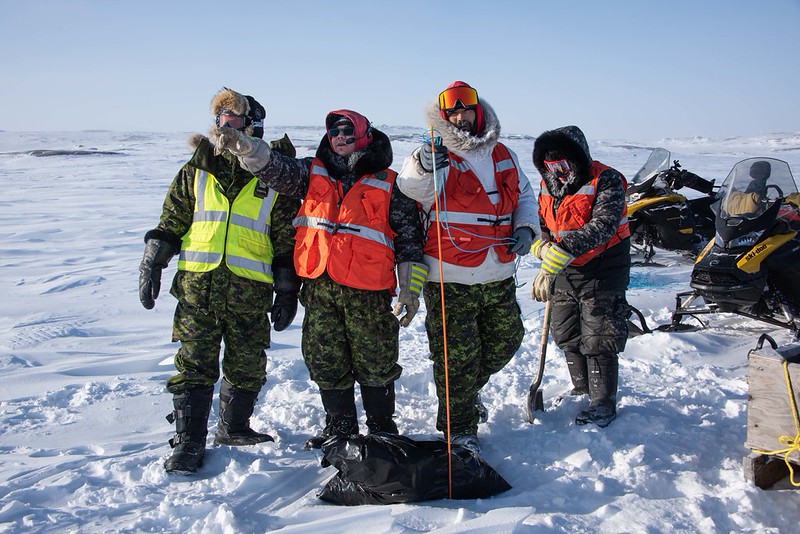
Indigenous Arctic communities possess valuable knowledge for enhancing environmental security in the North, and they are demonstrably eager to participate. Recent strategies published by several Indigenous organizations across Canada all position Indigenous peoples as not passive stakeholders but essential partners in Arctic security planning, with the knowledge, jurisdiction, and lived experience needed to help inform defence strategies in the North. In their Arctic Vision for Sovereignty, Security, and Defence, the Indigenous advocacy organization Inuit Tapiriit Kanatami (ITK) describes Inuit hunters, harvesters, and researchers as “the eyes and ears” of a vast geographical region including the entire Northwest Passage. These community members provide ongoing support to “the thin ranks of Canadian Coast Guard and Canadian Armed Forces personnel” in a region that is both strategically critical and expensive to monitor through conventional means alone.
The failure to meaningfully incorporate Indigenous knowledge into NATO’s security posture is not the result of a lack of will or capacity on the Indigenous side, but rather of a set of structural barriers on the institutional side. Historically, even when Indigenous knowledge has been formally recognized in policy, it tends to be sidelined in actual decision-making. In practice, Canadian programs that are officially labeled as “Indigenous-led” are frequently constrained by government frameworks that expect them to fit within pre-defined institutional boundaries and fail to translate to genuine knowledge-sharing or shared authority. Funding deficits present another obstacle: Indigenous organizations conducting environmental assessments often must rely on government or industry financing, which can limit their scope and independence.
Concrete Steps Towards Integration
Closing this intelligence gap will require concrete, intentional structural change at both the national and Alliance levels. Nationally, one immediate step the federal government could take is to establish dedicated and independent funding streams for Indigenous-led monitoring programs. Doing so would insulate these programs from government or industry project approval cycles, allowing Indigenous community members greater capacity to set program objectives, which is consistent with greater monitoring breadth and stronger intelligence outcomes.
At the Alliance level, Indigenous organizations should be granted formal advisory roles in NATO’s Arctic climate security work, potentially through the CCASCOE. The Arctic Council’s Permanent Participant system, which gives Indigenous peoples’ organizations recognized standing in circumpolar governance, offers a helpful model for how this could look.
Indigenous monitoring programs exist and are actively producing intelligence that would strengthen Arctic climate security, and Indigenous communities are unambiguously willing to collaborate. For too long, NATO’s approach to climate security has relied on a narrow definition of what counts as useful environmental intelligence that has systematically overlooked the kinds of long-term, place-based, relational environmental knowledge that Indigenous communities in Canada have developed for centuries. It is time to bridge this intelligence gap by building the appropriate institutional pathways to integrate Indigenous knowledge into NATO’s Arctic climate security architecture.