For decades, European security has depended on a core assumption: that the United States would act as its ultimate guarantor. Today, that assumption is no longer unquestioned. Russia’s war in Ukraine, intensifying geopolitical competition, and uncertainty surrounding long-term U.S. commitments have pushed European leaders to reconsider the foundations of their security. In response, the European Union has increasingly embraced the idea of strategic autonomy, understood as the capacity to act independently in defence, technology, and economic policy. Yet this shift creates growing tensions in transatlantic relations. Is a more autonomous Europe a stronger partner for NATO, or does it risk pulling the alliance apart? While European strategic autonomy is often framed as a challenge to NATO, its effects depend on whether it is pursued as capability-building within NATO or as an institutional alternative to it. When aligned with transatlantic priorities, it can reinforce collective defence and strengthen burden-sharing. However, if pursued as an alternative to NATO, it risks creating duplication, weakening coordination, and fragmenting Western security at a time when unity is most needed. This shift also carries important implications for NATO partners such as Canada, whose security and economic interests are closely tied to the stability of transatlantic relations and integrated defence and trade networks.
European strategic autonomy is not about distancing Europe from its allies, but about ensuring it can act when necessary, with or without external support. This ambition has taken clearer shape in recent years through initiatives such as the EU Strategic Compass (2022), the European Defence Fund, and Permanent Structured Cooperation, all of which aim to strengthen defence capabilities, improve coordination among member states, and reduce critical dependencies. Beyond the military dimension, strategic autonomy also extends to economic resilience and technological sovereignty, reflecting broader concerns over supply chain vulnerabilities, energy security, and digital infrastructure. This economic dimension is central to the debate. Efforts to reduce dependence on external actors have led the EU to promote industrial policy, defence production coordination, and supply chain diversification. While these measures aim to strengthen resilience, they also risk fragmenting transatlantic markets, particularly if European procurement policies favour domestic firms over NATO partners like Canada. Such shifts could reconfigure defence trade flows and raise concerns about protectionism within the alliance.
European strategic autonomy does not necessarily undermine NATO. Under the right conditions, it can actually strengthen the alliance’s effectiveness. One of NATO’s longstanding challenges has been uneven burden-sharing, with European allies often relying heavily on U.S. military capabilities. Although defence spending has increased significantly since 2022, longstanding capability gaps remain, as does reliance on U.S. support. By investing in defence through initiatives such as PESCO and the European Defence Fund, EU member states can begin to close these gaps, making Europe a more capable and credible security actor through improved coordination, readiness, and independent operational capacity. This, in turn, strengthens NATO by distributing responsibilities more evenly and enhancing collective readiness. A more capable Europe can also respond more quickly to regional crises, particularly in its immediate neighbourhood, including Eastern Europe and the Mediterranean, where EU-led missions may be better suited to act. Rather than replacing NATO, strategic autonomy is about building the capacity that allows Europe to contribute more meaningfully within it.
However, pursuing strategic autonomy also creates risks, especially if it is not carefully managed. Efforts to deepen EU defence integration can lead to duplication of capabilities and institutional overlap with NATO, particularly if parallel command structures or planning mechanisms emerge. This risks diverting limited resources away from existing alliance priorities instead of reinforcing them. For NATO partners such as Canada, which are integrated into transatlantic defence supply chains and rely on open procurement and trade frameworks, such duplication could increase costs, complicate defence cooperation, and disrupt established industrial linkages. More importantly, the political framing of autonomy may signal a gradual distancing from the United States, raising concerns about long-term commitment to NATO’s collective defence framework. Diverging strategic priorities between European states and the U.S. may further complicate coordination, especially in crises requiring rapid and unified responses. This is particularly evident in debates over crisis engagement, where European preferences for regional stability and diplomatic engagement may not always align with broader U.S. strategic priorities. In this context, strategic autonomy risks evolving from a complementary project into a competing one, potentially weakening the cohesion that has long underpinned Western security.
Europe’s response to Russia’s invasion of Ukraine clearly illustrates this dynamic. While NATO has played a central role in coordinating military support and reinforcing deterrence, the European Union has also expanded its role through financial assistance, sanctions, and joint defence initiatives. This dual-track response shows that EU actions can complement NATO’s military role rather than replace it. At the same time, it exposes underlying tensions, as European dependence on U.S. military leadership remains evident. The Ukraine case highlights both the potential and limits of strategic autonomy, showing that it remains constrained by enduring reliance on U.S. military capabilities.
Beyond Europe, the evolution of this approach carries broader implications for the international security order. As the global system becomes increasingly multipolar, the ability of Western alliances to remain cohesive will shape their capacity to respond to emerging threats, from great power competition to hybrid warfare. A fragmented transatlantic relationship would not only weaken deterrence but also create opportunities for rival powers to exploit divisions within the West. Conversely, a more capable and coordinated Europe could enhance the credibility of collective security arrangements and contribute to greater stability beyond its immediate region. In this sense, the debate over strategic autonomy is not simply a European concern, but a defining question for the future of global security governance.
The relationship between European strategic autonomy and NATO should not be understood as a zero-sum trade-off, but as a question of alignment and coordination. The key challenge lies in ensuring that EU initiatives are developed in ways that complement, rather than compete with, NATO’s existing structures. This requires sustained political commitment to transatlantic cooperation, a clear division of responsibilities, and mechanisms that promote interoperability between EU and NATO forces. In practice, this means framing strategic autonomy not as independence from NATO, but as a means of strengthening Europe’s contribution to it. At a time of growing geopolitical uncertainty, the effectiveness of Western security will depend less on institutional rivalry and more on the ability of these frameworks to operate in tandem. Ultimately, the impact of European strategic autonomy will depend not on its existence, but on whether it is institutionally embedded within NATO or evolves into a competing framework. This also requires recognizing that strategic autonomy is not only a security project, but an economic one, with direct implications for defence markets and transatlantic trade relations.
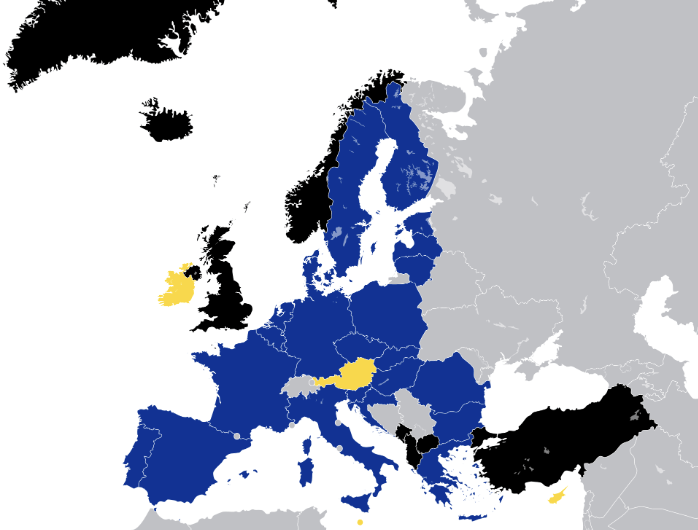
Photo: “EU and NATO membership map”, Ssolbergj via Wikimedia Commons. CC BY-SA 4.0.
Disclaimer: Any views or opinions expressed in articles are solely those of the authors and do not necessarily represent the views of the NATO Association of Canada.