Prime Minister Mark Carney’s speech at the World Economic Forum will likely be remembered as a turning point in Canadian foreign policy. This article argues that Carney’s emphasis on economic “strategic autonomy” exposes a vulnerability in the North Atlantic Treaty Organization (NATO): the alliance protects from tanks but not from tariffs. Carney declares that the longstanding rules-based international order has reached a final “rupture” and positions Canada’s energy and critical minerals as defensive tools independent of military alliances. The speech articulates a growing tension within NATO; while its mandate is rooted in collective defence against military threats, many contemporary security challenges now also emerge through economic and technological competition. For middle powers caught between contributing to collective defence while simultaneously protecting themselves from economic coercion by alliance members (including the United States), the gap is real. As allies begin to prepare for forms of economic coercion that Article 5 cannot address, the alliance’s founding assumption, articulated in Article 2, that economic integration among members would support collective security, is called into question.
Carney’s central argument is built upon the assertion that economic assets must now be viewed as coercive tools comparable to conventional military capability. Canada is positioning itself as an “energy superpower” with extensive reserves of the critical minerals which technology and defence sectors require; it is “no longer just relying on the strength of our values, but also the value of our strength”. By leveraging energy, food security and mineral wealth as bargaining tools, Carney positions economic assets as equally important to traditional military spending for national defence. His logic suggests a potential departure from NATO’s historical framework, in which military alliances were intended to protect trade. Now, the control of strategic trade assets is used to protect Canada from its own allies. Accordingly, Canada has strategically diversified its resource exports through signing deals with China on electric vehicles and canola oil; the EU on critical minerals; and Australia on rare earths. Canada’s evolving foreign trade diplomacy could mitigate United States (U.S.) tariff threats by reducing American leverage when alternative buyers (such as Brazil or China) can absorb key exports like uranium, potash and energy that U.S. sectors require.
Carney questions the postwar liberal order’s assumption that integration with larger powers inherently benefits middle powers. He argues that the “lie of mutual benefit through integration” has been exposed, as integration has instead become the root of middle-power subordination. His speech arrived amid growing tensions between the U.S. and Canada, highlighted by escalating trade wars and threats of 100% tariffs imposed by the Trump administration Carney’s reactionary pivot towards China, including a deal on electric vehicles and canola despite security warnings, highlights the possibility that middle powers may pursue external trade relationships beyond traditional allies in order to advance economic autonomy in an increasingly uncertain geopolitical environment. For NATO, persistent intra-alliance economic confrontation could challenge trust mechanisms within the alliance that underpin collective defence, especially when member states have fundamentally conflicting economic interests and are actively weaponizing trade against each other.
Canada faces a paradox in its current NATO commitments: it is expected to contribute to collective defence, yet it currently lacks the capabilities to fully meet these obligations. To address this gap, Canada has now doubled its defence spending to two percent of Gross Domestic Product (GDP) to meet NATO targets – a historic commitment that reversed decades of underinvestment. Nevertheless, structural constraints persist; Canada lacks force projection, nuclear deterrent and air-naval assets required to independently defend its territories, and still remains reliant on U.S. satellite intelligence. These capability gaps reflect issues that persist regardless of defence spending levels.
However, Canada’s defence dependence does not necessarily represent strategic freeloading, it may instead reflect a rational calculation. Canada is caught between competing pressures: it must contribute to collective defence while simultaneously protecting itself from economic coercion by the very alliance members it depends upon for military security. Canada’s economic hedging can thus be seen as a survival strategy. Ultimately, its commitment predicament reveals more about NATO’s structural limitations in an era where economic and military security do not always align than about Canada’s commitment to NATO.
Carney also suggested replacing NATO’s traditional consensus-based approach (where all members must agree before action) with a policy of “variable geometry”: flexible and specific coalitions rather than unanimous agreement. Canada is already utilizing this approach: in just six months, the Canadian government has signed twelve separate trade and security deals across four continents, such as the newest critical mineral deal with Australia. Shifting away from an exclusive reliance on consensus can be presumed as a last resort in a world where the “architecture of collective problem-solving” is being “diminished”. Bilateral economic arrangements do not replace NATO commitments. For example, by joining European defence procurement arrangements like SAFE (Security Action for Europe), Canada seeks to build an alternative third path through trade and investment that could possibly provide a strategic buffer against potential aggressions. The old international order is being contested and that middle powers must now cooperate issue-by-issue because, as Carney warned, “if you are not at the table, you are on the menu”. Carney’s variable geometry approach illustrates another structural limitation with NATO, where the consensus-based mandate designed for military defence lacks tools for economic security threats, leaving members to find ad hoc bilateral solutions that may undermine economic integration within the alliance.
This article argues that NATO currently lacks suitable tools to address modern security threats that are economic in nature. While Article 5 is clear about responding to traditional armed attacks, it remains vague and ineffective against tariffs, sanctions or the weaponization of supply chains. Yet energy access and critical mineral control increasingly determine military capability. A state that focuses on tanks and aircraft often ignores the fact that a state that cannot “fuel itself or defend itself” from economic coercion has no real sovereignty. In a time where economic vulnerabilities and strengths shape military capacity, NATO’s reliance on conventional defence logic leaves Canada ill-equipped to navigate this new era of “great power rivalry” that Carney describes.
The Davos speech outlines a critical reassessment of the alliance’s future. If NATO struggles to protect its members from the economic coercion of great powers, it may need to evolve its mandate to aid middle powers seeking comprehensive security that is not solely military-focused. Emerging debates within NATO about expanding the alliance’s scope to address hybrid threats, including cyber attacks and disinformation, face resistance from members wary of diluting Article 5. Carney addresses that Canada will no longer “live within the lie” of a rules-based order where the rules are not being followed by all parties. If Canada is to build a northern fortress–one that is economically, digitally, technologically and conventionally mighty–through economic resilience, it invites other middle powers to consider if they will remain participants in a potentially failing system or join a new order anchored in the “value of their strength”.
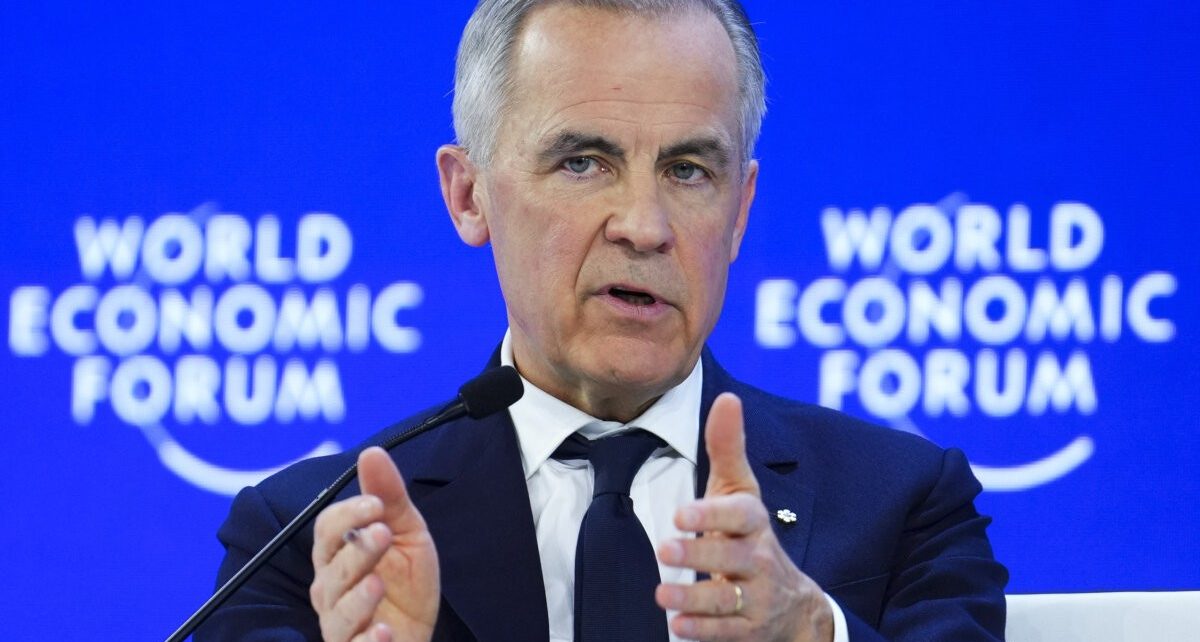
Photo: Mark Carney at the World Economic Forum (2026) by Sean Kilpatrick, The Canadian Press. Licensed under CC BY-SA 2.0.
Disclaimer: Any views or opinions expressed in articles are solely those of the authors and do not necessarily represent the views of the NATO Association of Canada.