At the outbreak of the Second World War, Prime Minister William Lyon Mackenzie King aphoristically said that he favoured “not necessarily conscription, but conscription if necessary” for Canada. Eighty years after the end of that war, Germany seems to believe that conscription has become necessary to meet NATO’s present security needs.
On August 27, 2025, the German government tabled a Military Service Modernization Bill, widely considered to be the first step in the reintroduction of conscription. The bill creates a military service questionnaire to be sent to all Germans turning 18 in 2026, which will be mandatory for men to complete. Most importantly, the bill enables the government to introduce conscription at any point in the future, including outside a state of emergency or war. A reintroduction of conscription in Germany would make it the eleventh NATO ally to embrace the policy, joining, among others, the Nordic and Baltic states on NATO’s external border.
Conscription has deep historical roots in Germany. Introduced first at the country’s 1871 unification, Germany later fielded massive conscript armies in the First and Second World Wars. Despite the inhumanities committed by German forces in the latter conflict, the postwar West German government introduced conscription in 1955 with the creation of the modern German armed forces, viewed as a necessary step for a country now on NATO’s frontline against communism. By the time of Germany’s abolishment of conscription in 2011, the country had experienced almost 140 years of conscription.
Unlike Germany, Canada has had no history of peacetime conscription. Canadians volunteered in sufficient numbers as to obviate conscription through most of the First World War, but when Prime Minister Robert Borden introduced conscription in 1917, he faced intense, concentrated opposition in Quebec, culminating in the Conscription Crisis and the Easter Riots. The legacy of the crisis endured in the Second World War. In 1942, Mackenzie King called a referendum to give him the mandate to renege on an earlier pledge against conscription. Though the referendum passed, the policy again faced concentrated opposition in Quebec.
Conscription has never been reintroduced in Canada. As for current Canadian attitudes on conscription, an Angus Reid survey from August 2025 found that though a large majority of respondents favoured the introduction of some kind of national civilian service in Canada, public opinion was evenly split on conscription. While this trend appears to be consistent across all provinces and between Anglophones and Francophones, conscription is considerably less popular in Canada than in Germany, where a July Ipsos survey showed that over 70 per cent of respondents were in favour of conscription.
This opinion discrepancy is hardly shocking when one considers that conscription is mostly alien to Canada, while even Germans of the millennial generation still have memories of conscription as a long-established rite of passage into adulthood. When the most salient cultural memories of conscription in Canada are those of crises of national unity, it cannot be prudent to introduce conscription without recognizing the need to frame it in a culturally appropriate light. Only with a concerted effort to emphasize the Canadian Armed Forces’ historical role in peacebuilding, humanitarian intervention, and defence of the rules-based international order, combined with an enhancement of its present undertakings, could make conscription a justifiable policy, both to the domestic public and to the CAF.
Turning to present military undertakings, an opprobrious similarity between Canada and Germany is that both states have, in the 21st century, been among the smallest military spenders in NATO. In 2014, Germany spent 1.19 per cent of its GDP on the military, while Canada spent 1.01. However, Germany’s spending has increased drastically since 2022, following then-Chancellor Olaf Scholz’s pledge to invest an additional 100 billion euros in defence at the “Zeitenwende”, or watershed, heralded by Russia’s unprovoked invasion of Ukraine. In 2024, German defence spending sits at 2.12 per cent of GDP – eighth highest in the alliance. Germany’s steps towards conscription, therefore, must be contextualized in this process of massively reinvesting in defence capacity.
Despite committing this year to meeting NATO’s previous 2 per cent target, Canada has failed to keep pace in the same period, reaching just 1.37 per cent of GDP spent on defence in 2024 following erratic budget fluctuations. The legacy of the “decade of darkness” still looms large in the CAF, which continues to experience supply shortages to the point where Canadian soldiers on NATO deployment in Latvia have been forced to purchase their own equipment out of pocket. It would therefore be logistically impossible under present circumstances to introduce peacetime conscription in Canada for the first time, when prospective soldiers, sailors, and aviators can expect to wait months before entering basic training due to a training bottleneck. What’s more, serving members are increasingly unwilling to stay in the CAF, which Mark Carney’s government has tried to remedy with a substantial pay rise in August 2025. When frustrations with training and morale are driving serving members out of the Forces, the solution to the retention crisis cannot simply be to make service universally mandatory.[OK1]
Germany’s steps towards conscription come at a time when it has already firmly set down the path of rearmament. It is then hardly logical for Canada to introduce the same policy when we have just begun the long process of seriously attempting to meet our NATO obligations. Whether conscription is a cultural institution worth implementing to cap off the Canadian rearmament, however, is an entirely different question for future governments.
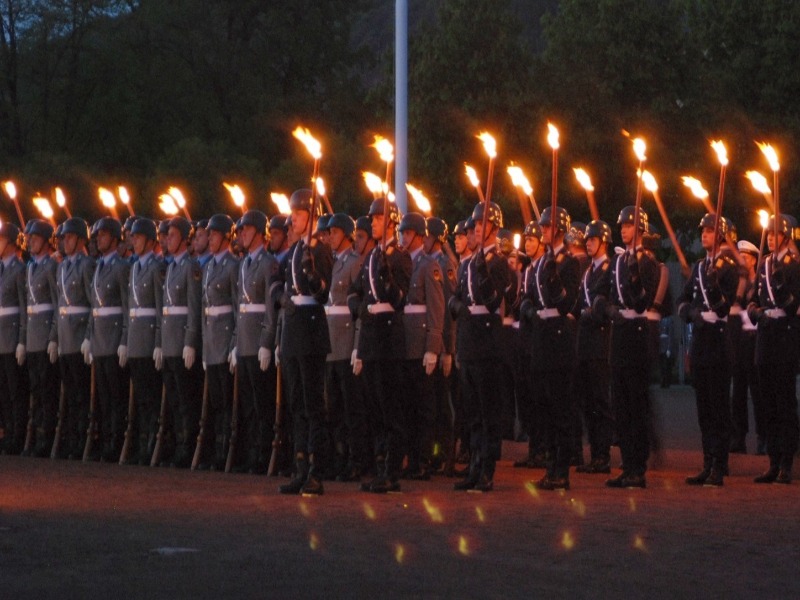
Photo: Grand Tattoo (2008) by Herald Post via Flickr. Licensed under CC BY-NC 2.0.
Disclaimer: Any views or opinions expressed in articles are solely those of the authors and do not necessarily represent the views of the NATO Association of Canada