In April 2026, Canada worked with NATO’s Defence Innovation Accelerator for the North Atlantic (DIANA) to meet a defence capability need. This led to a research and development contract awarded to HonuWorx, a UK-based subsea robotics company, to help Canada explore deeper-water defence research operations. It was the first contract awarded on behalf of a NATO member state through DIANA’s Rapid Adoption Service (RAS). The RAS allows DIANA to award contracts to allies who choose to participate, aiming to speed up technology adoption across NATO.
Canada plays an important role in NATO’s defence innovation network. Halifax is home to DIANA’s North American regional office, and the Centre for Ocean Ventures and Entrepreneurship (COVE) in Dartmouth acts as an accelerator site. Canada also hosts 16 of DIANA’s 200-plus test centres, which gives innovators places to test and validate new technologies. Private-sector firms are also highly involved. For DIANA’s 2026 cohort, 150 innovators from 24 NATO countries were selected from almost 3,700 submissions, and 22 are Canadian. Canada submitted more applications than any other member state, and the Government of Canada provides additional funding to DIANA-selected Canadian innovators, further supporting their participation in the program.
Although Canada has a strong presence, the first RAS contract for a NATO member state went to a UK-based company. This illustrates an important distinction: strong participation in DIANA does not automatically translate into procurement opportunities for Canadian companies, or the adoption of their technologies by the Canadian Armed Forces (CAF).
One of the hardest parts of defence innovation comes after a technology has been developed and tested: getting the military to adopt it. While programs such as DIANA and Innovation for Defence Excellence and Security (IDEaS) support technology development and testing, moving promising solutions from successful trials into defence procurement demands a separate process. Canada has developed programs to support defence innovation, but it still needs a clear process to connect promising DIANA companies with Canadian defence needs and move technologies from successful testing towards CAF acquisition. A slow pipeline from testing to procurement hinders both the CAF, which risks missing out on promising domestic solutions, and Canadian companies, which may struggle to scale, attract investment and retain the economic benefits of their innovations in Canada.
Canada already knows that defence innovation needs a way to reach acquisition, and has made progress developing systems to streamline this process. The IDEaS program, for instance, funds innovators, supports technology development, and lets the CAF test solutions. The 2023 evaluation of IDEaS by the Department of National Defence (DND) pointed out that there is still uncertainty about what happens next, including how to commercialize a solution once it is ready. It also found that IDEaS had not yet reached the point where developed solutions could be procured, as acquisition was not part of the program’s original scope.
The Procurement and Operationalization of Innovation and New Technologies (POINT) pilot takes this further by setting up a six-stage process from development and testing to possible acquisition. That said, POINT only applies to certain IDEaS challenges, and getting funding does not mean a purchase is guaranteed. Neither program gives DIANA companies a clear path from testing to Canadian defence procurement. The HonuWorx contract shows Canada has started using RAS to link DIANA technologies with defence needs, but a more predictable path is still needed from successful testing to buying these technologies at home.
The Office of the Procurement Ombud’s report on major defence procurement further noted that long timelines and a fragmented system create difficulties for suppliers, especially small and medium-sized businesses. On average, major defence projects take about 16 years to complete. These barriers make a clear and timely route from successful testing to procurement particularly important for Canadian innovators. Canada is also working on broader procurement reforms, such as the Defence Investment Agency (DIA), to streamline procurement. The key question now is how these changes will help DIANA participants connect with the CAF and acquisition processes. These reforms provide an opportunity to establish that connection, but a clear route from DIANA testing to Canadian acquisition still needs to be defined.
DIANA operates across NATO and does not guarantee Canadian companies defence contracts, meaning that these companies can find customers among other allied states. Canada hosts a regional office, an accelerator site and test centres, while Canadian companies are applying to DIANA in significant numbers. Given this investment, it makes sense to ensure that the CAF can also draw on the innovation pipeline Canada is helping to support. With a clearer connection to Canadian acquisition, Canada will be better positioned to realize the domestic benefits of its investment.
The United States provides a good example with its Defense Innovation Unit (DIU), which was set up to accelerate the military adoption of commercial and dual-use technologies. By using faster contracting methods like Other Transaction (OT) authority, DIU aims to bring promising technologies to military use in months instead of years.
Canada could draw on this approach to establish a clear process for connecting DIANA companies with Canadian defence requirements. The 2026 Defence Industrial Strategy aims to create or improve faster purchasing routes within innovation programs like IDEaS and Innovative Solutions Canada. Extending those faster routes to DIANA companies whose technologies match a Canadian need would align Canada’s NATO innovation goals with its own defence priorities.
First, DND should identify the right CAF end users early in the DIANA process. If military personnel review technologies during development and testing, they can assess whether the solutions meet operational needs and flag needed changes before companies invest further in development.
Second, Canada should fund follow-up trials of promising technologies that meet standards set with the CAF. These trials would test performance in real-world settings and show whether a technology is ready for use. Where possible, DND could build on existing IDEaS and POINT programs to support this.
Third, the process should make it clear how a successful trial can lead to an initial purchase. If the technology meets the operational need, DND funding is available and the procurement rules allow it, the DIA should be positioned to support the move from trial to acquisition. It can also do this by clarifying who is responsible, which procurement pathway applies and what the next steps are. RAS, which DRDC used in the HonuWorx contract, is an example of how such purchases can be made.
The process should also track results. Useful measures include the percentage of Canadian DIANA companies that reach follow-on trials or get a Canadian contract within a set time, the number of contracts awarded, and which technologies are adopted.
Without these targets, Canada cannot know if its investment is building capability.
Canada’s next step is to ensure its promising innovators can move just as clearly from testing to military adoption. Linking DIANA more closely to Canada’s new procurement reforms would be a key step in turning investment in defence innovation into actual military capabilities and would provide Canadian companies with more opportunities to grow. In the end, Canada’s success will be measured by whether the technologies it supports meet the needs of its own armed forces.
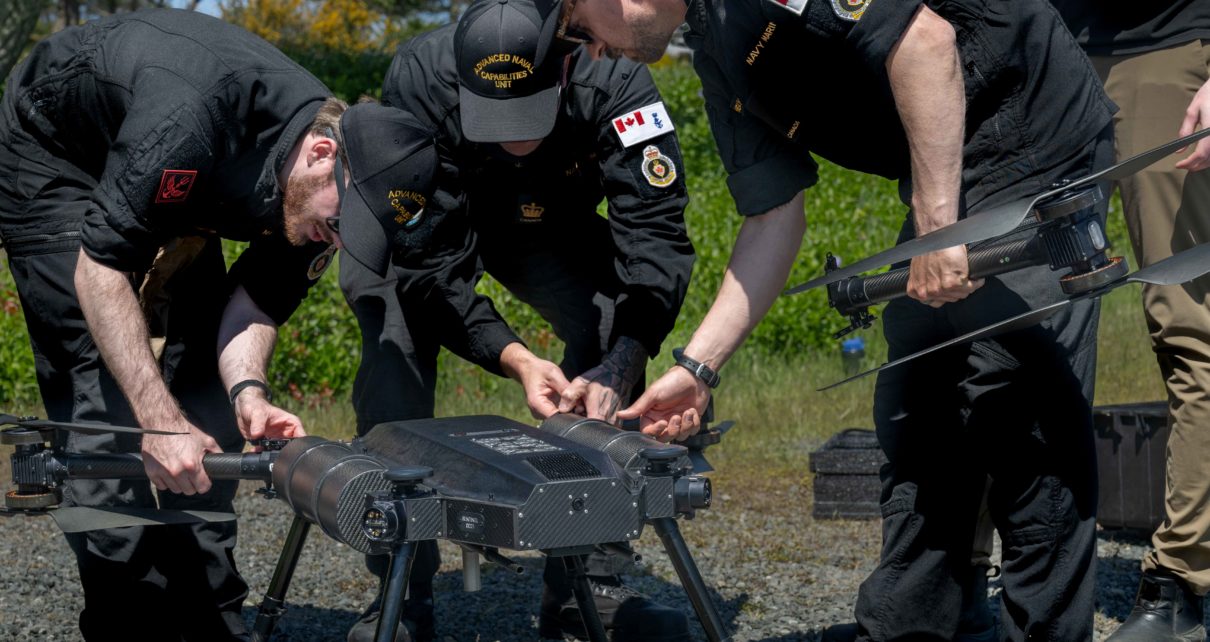
Photo: Members of the Advanced Naval Capabilities (ANC) Unit assembling a modular uncrewed aerial system during Exercise Nomad Citizen (2026), by Corporal Conor R.G. Munn via Canada.ca. Photo courtesy of the Department of National Defence.
Disclaimer: Any views or opinions expressed in articles are solely those of the authors and do not necessarily represent the views of the NATO Association of Canada.