Climate change is not a distant threat; it is already reshaping nations, identities, and security. While much of the world debates its consequences, the reality is inescapable for the Pacific Island nation of Tuvalu; as rising seas threaten its very existence. Located midway between Hawaii and Australia, Tuvalu may not exist in a matter of years due to sea-level rise. In response, Tuvalu has declared itself “The First Digital Nation” at the United Nations Climate Change Conference (COP27) in 2022, seeking to preserve its culture, sovereignty, and identity in a digital form. Meanwhile, Tuvaluans are migrating to Australia under climate-visas, becoming among the world’s first climate refugees; people forced from their homeland by climate change.
Where does Canada fit in? According to the Government of Canada’s National Inventory Report, in 2023 Canada’s greenhouse gas emissions fell to 694 million tons of carbon dioxide, marking one of the lowest levels in 27 years (outside of the pandemic years). While this shows progress in reducing emissions intensity, down around 34% since 2005, the scale of climate impacts both globally and in Canada’s North means that improvement must accelerate. Canada still emits well above its proportion of the global population and remains implicated in the harms suffered by vulnerable nations. Its emissions contribute to the existential challenges faced by vulnerable nations like Tuvalu, but also bring climate security threats to Canada’s own Arctic.
Arctic temperatures are increasing nearly four times faster than the global average since the late 1970s. This warming accelerates sea-ice melt, permafrost thaw, and coastal erosion. For Indigenous communities across Nunavut, the Northwest Territories, and Yukon, these changes undermine multiple dimensions of security. Food security is threatened as rising sea levels and unstable sea ice disrupt access to country foods, alter fish migration, and degrade marine ecosystems essential for livelihoods. Cultural security is undermined as encroaching waters erode sacred sites, seasonal camps, and burial grounds, weakening intergenerational knowledge transfer and spiritual connections to the land. The Indigenous Climate Hub highlights that global sea levels have already risen 10–20 cm over the past century and could increase by up to 90 cm by 2100, intensifying the risks of flooding, shoreline loss, and ecosystem collapse. These dynamics also create physical security concerns, as permafrost thaw and coastal erosion destabilize homes, airstrips, and critical infrastructure, forcing some communities to consider relocation. More broadly, sovereignty and human security are undermined with Indigenous Peoples being exposed to climate hazards that threaten their survival, cultural integrity, and self-determination. Rising sea levels are seen as a profound security challenge for Indigenous communities in northern Canada.
The parallel between the Pacific Islands and Canada’s Arctic lies in how climate change transforms security. For the Pacific, the threat is territorial disappearance and the survival of Tuvaluans. For Canada, it is the destabilization of its northern frontier, where rising sea levels, thawing permafrost, and coastal erosion degrade vital infrastructure and complicate defense operations. According to the 2024 NAADSN Canadian Arctic Climate Change and Security Impact Assessment, shifting environmental conditions increasingly constrain Arctic missions by damaging runways, ports, communications points, and support infrastructure, thereby weakening the resilience of Canada’s northern defense. The rising levels of sea water accelerate erosion and flooding, further undermining facilities that support sovereignty in remote coastal Arctic regions. Canada’s primary sovereignty exercise, Operation Nanook, is designed to project presence, train the Canadian Armed Forces under Arctic conditions, and coordinate with allies and local communities. Yet, as sea levels rise and infrastructure stability declines, sustaining such operations will become more logistically complex and resource-intensive. In this context, the erosion of infrastructure and the potential displacement of northern communities not only endanger Indigenous security but also threaten Canada’s ability to defend and assert sovereignty over its Arctic territory.
Canada cannot afford to delay its response to climate change. The warming Arctic is not a distant possibility but a current reality for Indigenous survival and national defense. To uphold its global responsibilities and protect its own citizens, Canada must act now by investing in resilient Arctic infrastructure; embedding Indigenous leadership and knowledge into adaptation strategies; cutting emissions far beyond current trajectories; and aligning policy with its Sustainable Development Goals. Canada is already facing challenges advancing SDG 13: Climate Action. Failure to meet the Sustainable Development Goals is a climate security emergency. Climate change knows no borders, and neither can Canada’s response. The stability of Canada’s Arctic sovereignty rests on viewing Tuvalu’s fate as an early indicator of systemic crisis, not as a distant calamity. The choice is very clear; Canada must act decisively today, or inherit a world where entire nations and cultures, at home and abroad, are left to disappear beneath the tide. The survival of the world, not only these two nations, depends on collective transformation. Tuvalu and Canada’s Arctic exemplify the urgent need for global solidarity, climate justice, and decisive systemic change.
Any views or opinions expressed in articles are solely those of the authors and do not necessarily represent the views of the NATO Association of Canada.
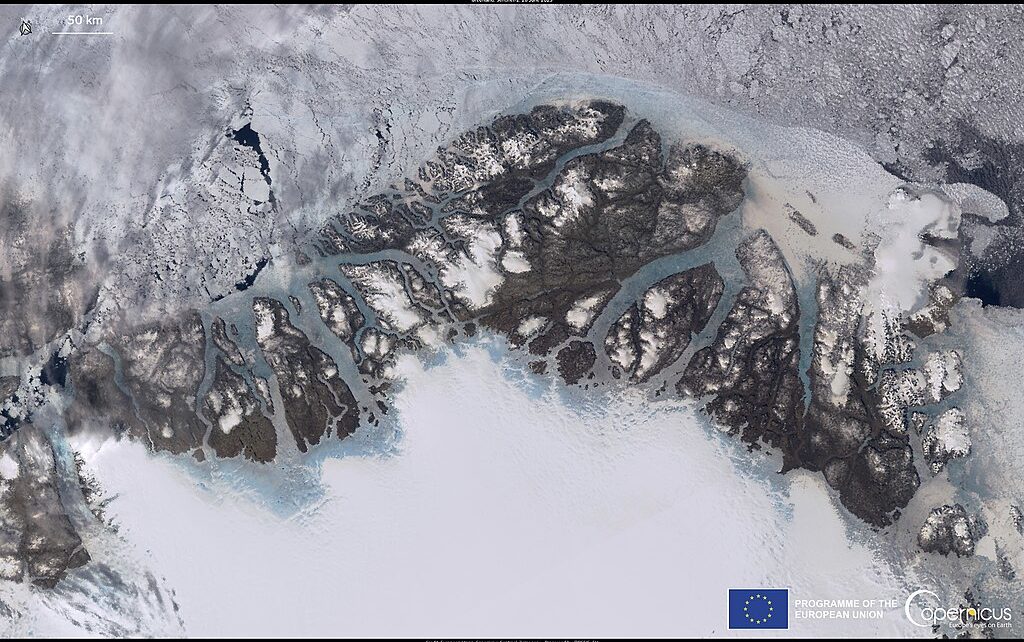
Photo: “Heatwave in Greenland triggers widespread surface melting” by the European Union / Copernicus Sentinel‑3 Programme. Licensed under Creative Commons CC 0. Wikimedia Commons.