In October 2026, the Chinese Communist Party (CCP) expelled a record 33 members during its Central Committee’s 5th plenary session. Furthermore, of the 376 full and alternate Central Committee members named in 2022, only 279 attended, marking a staggering 25% absence rate. The largest group affected, however, was the People’s Liberation Army (PLA), in which 16 senior military officials were purged, most prominently Chinese President Xi Jinping’s long-time secretary, Lieutenant General Zhong Shaojun, and the former vice chairman of the Central Military Commission (CMC) and China’s highest-ranking military officer, General Zhang Youxia. Some academic scholars have called the meeting the CCP’s “biggest purge in history.”
Since 2023, an unprecedented wave of purges has swept the Chinese military and defence technology industries. Of the seven members of the CMC, China’s top military authority, all have been expelled from the CCP except for one, General Zhang Shengmin, the PLA’s anti-corruption chief. Notably, Zhang was the only official promoted during the 5th plenary session, having been elevated to the Politburo, the country’s most senior political body.
Both the PLA’s forward-operating troops and its defence technology industries have been severely affected. Of the five PLA Theater Commands, the Chinese military’s combatant commands, nearly all of its commanders and political commissars have either been expelled, demoted, or disappeared from public view. Leadership in the PLA service branches, responsible for training, equipment procurement, and logistics, has also been drastically purged. The PLA Rocket Force, which manages China’s strategic and tactical missile arsenals, was hit hardest, with all four successive commanders expelled from the military and their ranks stripped between 2023 and 2026. In other words, the command structure of the Chinese military has been completely gutted.
However, assumptions that the widespread damage to China’s military structure would render the PLA unable to operate in the Indo-Pacific or conduct a Taiwan combat contingency in the long term are worth approaching with caution. The Pentagon’s 2025 Chinese security report to the United States Congress characterized China’s military modernization plans as a long-term ambition, sequenced through three distinct stages: accelerate mechanization and modernization of military theories by 2027, complete modernization of national defence by 2035, and fully transform its armed forces into a world-class force by 2049. While the current purge campaign raises understandable questions about the PLA’s short-term operational readiness, it does not necessarily signal a long-term military deterioration. The Chinese military has recovered from previous severe leadership and structural instability.
Anti-corruption efforts in the military are not unprecedented and have been ongoing since President Xi’s ascension to power in 2012. Top Chinese generals have been expelled before, notably in 2014-2015, when two former CMC vice chairmen, Generals Guo Boxiong and Xu Caihou, were arrested for massive corruption cases. In 2017, the PLA’s chief of the Joint Staff, General Fang Fenghui, and the military’s top political officer, General Zhang Yang, were both expelled. Both cases were accompanied by waves of collateral damage that greatly affected the PLA’s leadership core.
Yet in both cases, the PLA successfully recovered its position, and the lack of senior commanders has not stopped the military from regaining its trajectory towards rapid military modernization. In 2015, the PLA institutionalized its largest structural reforms, including a complete restructuring of the CMC into 15 specialized departments under a centralized command structure, the creation of multi-service joint operational theatre commands, and the establishment of a national command centre, which placed Xi as its commander-in-chief. Between 2017 and 2024, Chinese military spending grew by $94 billion USD, and the Chinese navy, which had 306 ships in 2017, possessed 332 in 2023, with a projection of 48% more ships by 2030. The Chinese air force, which only had six 5th-generation fighters in 2017, had 230 by 2024. In 2025, despite the widespread leadership crisis, the PLA increased its military operations in the Taiwan Strait, South China Sea, and near Japan.
Thus, command-structure setbacks for the PLA have not been a long-term obstacle to Chinese military growth over the last 15 years, as shown by its ability to continuously expand and modernize its infrastructure. In accordance with its own strategic blueprint for military modernization, China remains on track to accomplish its long-term security objectives.
However, the ongoing purge campaign will create critical short-term setbacks which may give NATO members and Indo-Pacific partners a window to bolster defences. While leadership gaps in the PLA may not threaten military growth, they severely restrain the military’s operational capabilities. General Zhang Shengmin, the only remaining CMC member, is a career political officer and lacks combat operations experience. Furthermore, the chiefs of the Joint Staff Department, Joint Operations Command Center, and the Logistics Support Department, which are the backbone of conducting the PLA’s forward operations, remain unfilled. These vacancies will create a temporary environment in which any Chinese efforts to conduct major military operations that require large-scale mobilization and organization will be greatly constrained.
U.S. officials, in a report published by Reuters in October 2026, believe a Chinese invasion of Taiwan would be unlikely before 2028. The U.S. intelligence community, in its annual threat assessment, also stated that China lacks any invasion plans for next year, despite President Xi’s public instructions for the PLA to be ready for such an operation by 2027. The setbacks sustained by the ongoing anti-corruption campaign may help explain the delay. Delays in the PLA’s preparation of military exercises last year, specifically in its Strait Thunder-2025A exercise in April and Justice-Mission 2025 exercise in December, suggest that operational readiness may not have reached satisfactory expectations. Furthermore, lessons from the wars in Ukraine and Iran could also have warranted increased caution and hesitation from military decision-makers. As a result, the likelihood of the Chinese military launching a major combat operation will remain slim in the short term.
The current setback therefore creates a significant window to counter the growing potential threats of Chinese military activity. Increasing unified joint operations between NATO and allied partners to solidify a stronger presence in the Indo-Pacific will strengthen deterrence against a weakened PLA. Through Operation HORIZON, Canada is an increasingly active regional actor. By raising its deployments through a joint-coordination exercise, the Canadian Armed Forces will play an integral role in countering China’s increasingly assertive behaviour while mitigating coercive actions in the region, as required by Canada’s Indo-Pacific Strategy. It is crucial to seize the chance to strengthen collective deterrence and consolidate a durable allied posture against Chinese strategic interests while NATO and allied forces hold the momentum. China’s reduced combat capabilities do not mean reduced ambitions on contingencies in Taiwan, the South China Sea, and the East China Sea. These ambitions must be contained to the maximum extent possible before Beijing regains its footing, and the best time to do so is now.
Disclaimer: Any views or opinions expressed in articles are solely those of the authors and do not necessarily represent the views of the NATO Association of Canada.
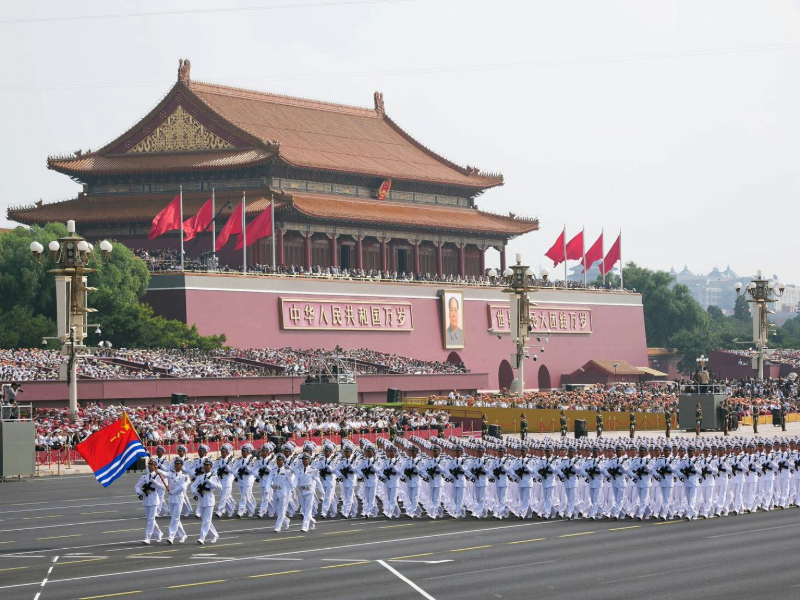
Featured Image: Members of the People’s Liberation Army Navy (PLAN) marching in front of Tiananmen during the 2025 China Victory Day Parade. Photo by the Press Service of the President of Azerbaijan is licensed under CC BY 4.0.