While the ongoing physical expansion of Camp Schwab in Henoko remains an operational necessity to deter a Taiwan contingency, its strategic viability is severely threatened by a 70-year structural friction loop, recently laid bare once again by the October 2026 arrest of US Marine LCpl Devin Jacob Ballard in Naha.
Because standard US military reactions such as short-term operational stand-downs, midnight curfews, and off-base alcohol bans fail to remedy these deep-seated systemic flaws, newly elected Okinawa Governor Genta Koja and the Prefectural Assembly have strongly reiterated demands for a fundamental overhaul of the 1960 Status of Forces Agreement, prompting Prime Minister Sanae Takaichi to lodge formal protests directly with Washington. This position reflects a pragmatic balance between national defence and local justice. While Koja accepts the strategic presence of U.S. forces, he firmly rejects legal loopholes that shield suspects from local law enforcement. For local leadership, hosting military bases for national security does not eliminate the need to reform SOFA to ensure residents are protected under Japanese jurisdiction.
To resolve the ongoing tensions between Okinawa and the central government, Tokyo and Washington must modernize SOFA administrative protocols to remove operational investigative barriers while shifting toward a strategy of “Capability Substitution.” This means maintaining the firepower, surveillance, and combat readiness needed to defend the region- as demonstrated in the Keen Sword exercises, which commenced Oct. 19, 2026, when Japan deployed long-range Type 25 surface-to-ship missiles outside their home garrison in Kumamoto for the first time, involving approximately 45,000 Japanese Self-Defense Forces. Operating from Kyushu with a 1,000-kilometre reach, these mobile kinetic strike assets can cover maritime approaches toward Taiwan and the southwestern islands without needing to be permanently stationed in Okinawan municipalities. On the other hand, capability substitution also includes replacing large, permanent bases and personnel footprints with alternative military means, such as non-kinetic NATO frameworks in cyber, space, and emerging technologies. Although Japanese police secured direct custody of Ballard because he was apprehended off base, the case exposed the persistent structural vulnerability of the Asymmetric Consent Gap whenever suspects reach military perimeters. This gap refers to the legal loophole that occurs when a suspect reaches base property. Once on U.S. military grounds, American authorities take primary custody, preventing Japanese police from entering or taking control without explicit U.S. consent. Consequently, host-nation police lose jurisdiction simply due to a physical boundary. Updating these administrative procedures, rather than pursuing a politically volatile, full treaty renegotiation, fixes this systemic flaw directly. Specifically, this means guaranteeing Japanese investigators automatic joint forensic access to evidence on base grounds and establishing clear pre-indictment custody terms, so suspects are handed over to local police without bureaucratic delays. In doing so, both governments can remove a main driver of local friction and restore trust in the alliance.
The alleged October 2026 robbery murder of 39-year-old Anna Yagi in Naha by US military service member LCpl Devin Jacob Ballard of the III Marine Expeditionary Force has elevated civil-military tensions in Japan back to the level of a national crisis. The incident fits seamlessly into a decade-long pattern of severe crimes, following historical precedents in 1955, 1995, and 2016, proving these events are not isolated acts of misconduct. Rather, they are the predictable outcome of permanently housing thousands of forward-deployed troops inside gated base enclaves that foster cultural alienation, social isolation, and an extraterritorial garrison mentality toward the surrounding civilian population. Temporary curfews do nothing to alter the core legal barriers that constrain Japanese sovereignty in practice. Although Article XVII of the US-Japan SOFA formally grants Japan primary jurisdiction over off-duty crimes, actual law enforcement authority remains crippled by US consent mechanisms.
The US military leadership’s operational response demonstrates the narrow limits of traditional alliance crisis management. Lt. Gen. Benjamin Watson, commander of the III Marine Expeditionary Force, ordered a 48-hour suspension of military operations for mandatory discipline training, along with a strict midnight-to-5:00 a.m. curfew and a blanket 30-day-off-base alcohol ban. However, these reactive steps only treat the symptoms, tackling violent crime as short-term misconduct rather than addressing the structural strain borne by host communities. Because these internal troop orders carry no permanent institutional consequences for the alliance framework and are routinely lifted once media attention fades, they evaporate without generating any lasting preventive effect.
Alliance traditionalists and Pentagon strategists argue that formal revisions to the 1960 U.S.-Japan Status of Forces Agreement are politically perilous, fearing that jurisdictional concessions to Tokyo would prompt other strategic partners, like South Korea, to demand equivalent renegotiations. In addition, U.S. defence attorneys view pre-indictment custody protections as essential safeguards against Japan’s “hostage justice” system (hitojichi shihō), which allows prolonged detentions without legal counsel. However, this objection misinterprets the proposed reform, which avoids high-risk treaty renegotiations requiring Senate ratification. Washington and Tokyo can instead utilize the bilateral Joint Committee to implement targeted operational adaptations, such as Agreed Minutes or updated guidelines, without altering the foundational text. Resolving these procedural inequalities in forensic access and custody handovers protects host-nation domestic consent, while eliminating a primary vulnerability exploited by regional adversaries.
The ongoing expansion at Camp Schwab in Oura Bay is officially framed as a simple relocation of MCAS Futenma. Still, it represents the construction of an advanced facility designed to host the restructured 12th Marine Littoral Regiments for maritime interdiction in a Taiwan contingency just 60 nautical miles away. While the physical expansion of Camp Schwab in Henoko remains an immediate operational necessity to deter a Taiwan contingency, this reality does not preclude the integration of capability substitution. In the short term, concrete infrastructure provides critical staging and deterrence; over time, however, as long-range precision fires, unmanned systems, and Japanese Self-Defense Force capabilities mature along the Ryukyu chain, the necessity for massive, static physical footprints in Okinawa can be progressively reduced.
Because a forward military posture cannot endure indefinitely against the active resistance of its host population, Tokyo and Washington must pursue a complementary strategy on two fronts. First, they must modernize SOFA administrative protocols to grant Japanese law enforcement automatic, joint forensic access and transparent pre-indictment custody handovers without full treaty renegotiation. Second, they must execute a long-term “Capability Substitution” strategy by expanding Japan’s Individually Tailored Partnership Programme (ITPP) within the broader NATO Indo Pacific 4 framework alongside Australia, South Korea, and New Zealand. By deepening non-kinetic integration into active cyber defence through NATO’s CCDCOE, space domain awareness, dual-use AI innovation and uncrewed autonomous systems that reduce the required human troop footprint, Japan can build high-capacity cross-domain deterrence that generates a minimal physical footprint on Okinawan soil, reconciling national security commitments with domestic political legitimacy.
Disclaimer: Any views or opinions expressed in articles are solely those of the authors and do not necessarily represent the views of the NATO Association of Canada.
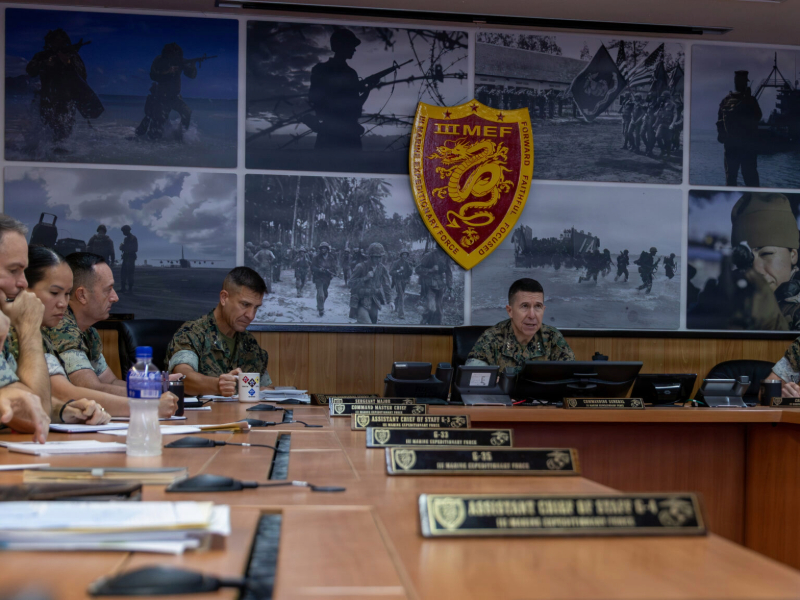
Photo: U.S. Marine Corps Lt. Gen. Benjamin T. Watson speaks with key leaders during a staff meeting on Camp Courtney, Okinawa, Japan, Oct. 6, 2026, by U.S. Marine Corps photo. Public domain via DVIDS, as published in USNI News.